
News
Can AI Save Your Relationship? This New “Wingman” App Thinks It Can
Built by wives and designed for husbands, Good Husband is a new Claude-powered AI communication coach aiming to help men navigate difficult relationship conversations, one text at a time.


We’ve officially crossed the rubicon where artificial intelligence is no longer just optimizing our spreadsheets, fixing our code, or generating corporate slide decks. It’s moving into the most fragile, inherently messy sandbox of all: human relationships.
According to research from the Centre for the Governance of AI’s Global Dialogues study, a staggering 42.8% of people globally already lean on AI for emotional support or personal issues at least once a week. Now, a new consumer tech platform wants to institutionalize that habit for men who find themselves staring blankly at a text thread, totally at a loss for words.
Enter Good Husband, an AI-powered relationship communication wingman that has officially launched to help men navigate high-stakes, emotionally charged conversations with their partners.
Built by entrepreneurs and long-time business partners Zainab Imichi Alhassan and Sarah Curtis, the platform wasn’t designed to replace couples therapy. Instead, it acts as a real-time translator for the digitally tongue-tied. The premise is simple: many men care deeply about their partners but lock up when it comes to emotional articulation or resolving conflicts.
“Good Husband is for the man who already cares. He just needs the words,” co-founder Zainab Imichi Alhassan explained. “Often the issue is not a lack of care, it’s a lack of confidence in how to express what you’re trying to say in the moment”.
How It Works: Warm, Direct, Or “Your Voice”

Operating entirely in a web browser without the need for partner participation or lengthy onboarding, the platform allows users to paste a text message, describe a tense situation, or explain an ongoing argument. The AI then spits back three distinct text response options: Warm, Direct, and Your Voice.
For those who actually want to learn from their communication missteps rather than just copying and pasting a quick fix, the platform features a coaching mode. This tool deconstructs the underlying emotional dynamics of the conversation, explaining why a partner might be upset and how to address the root issue.
While the baseline platform runs on Anthropic’s Claude AI to handle multilingual, global conversations, subscribers can unlock a hyper-personalized layer called Better Husband. By feeding the AI a localized relationship profile — including love languages, key dates, communication preferences, and recurring areas of tension — the tool moves away from generic advice and moves toward bespoke conflict resolution.
This pivot toward emotional utility marks a fascinating shift in consumer tech. As we see more platforms leverage advanced language models to solve hyper-specific human pain points, the intersection of tech and regional innovation continues to prove that AI’s most valuable feature might not be productivity, but empathy amplification.
“The opportunity is not to replace human connection but to strengthen it,” says co-founder Sarah Curtis. “Technology has changed how we work, learn and communicate. We believe it can also help people become more thoughtful partners”.
Pricing And Future Roadmap
Good Husband is launching with a tiered subscription model:
- Free Plan: Includes 5 baseline conversations per month.
- Good Husband ($9/month): Unlocks unlimited conversations, Coaching Mode, tone selection, and the Better Husband profile.
- Great Husband ($19/month): Adds automated date reminders (birthdays, anniversaries), situation playbooks, and love language coaching.
The web-based launch is only phase one. The company is already building a WhatsApp-native experience — allowing men to pull their AI wingman directly into their daily chat flows — alongside a future mobile app featuring coaching streaks and proactive communication prompts.
Whether outsourcing your relationship articulation to a large language model sounds like the future of emotional intelligence or a dystopian shortcut, one thing is clear: the AI wingman era has arrived.




News
Abu Dhabi’s Robot Kitchen Is Serving Up Biryani, Not Burgers
Circus SE wants to put a tiny automated factory inside the buildings where Gulf residents live and work, bypassing part of last-mile delivery.


The most telling thing about a new autonomous kitchen now running in Abu Dhabi’s Marina Square is what it won’t cook:
“We don’t do fast food,” says Nikolas Bullwinkel, Founder and CEO of Circus SE. “We’ve actively decided not to build a machine that can only do burgers”.
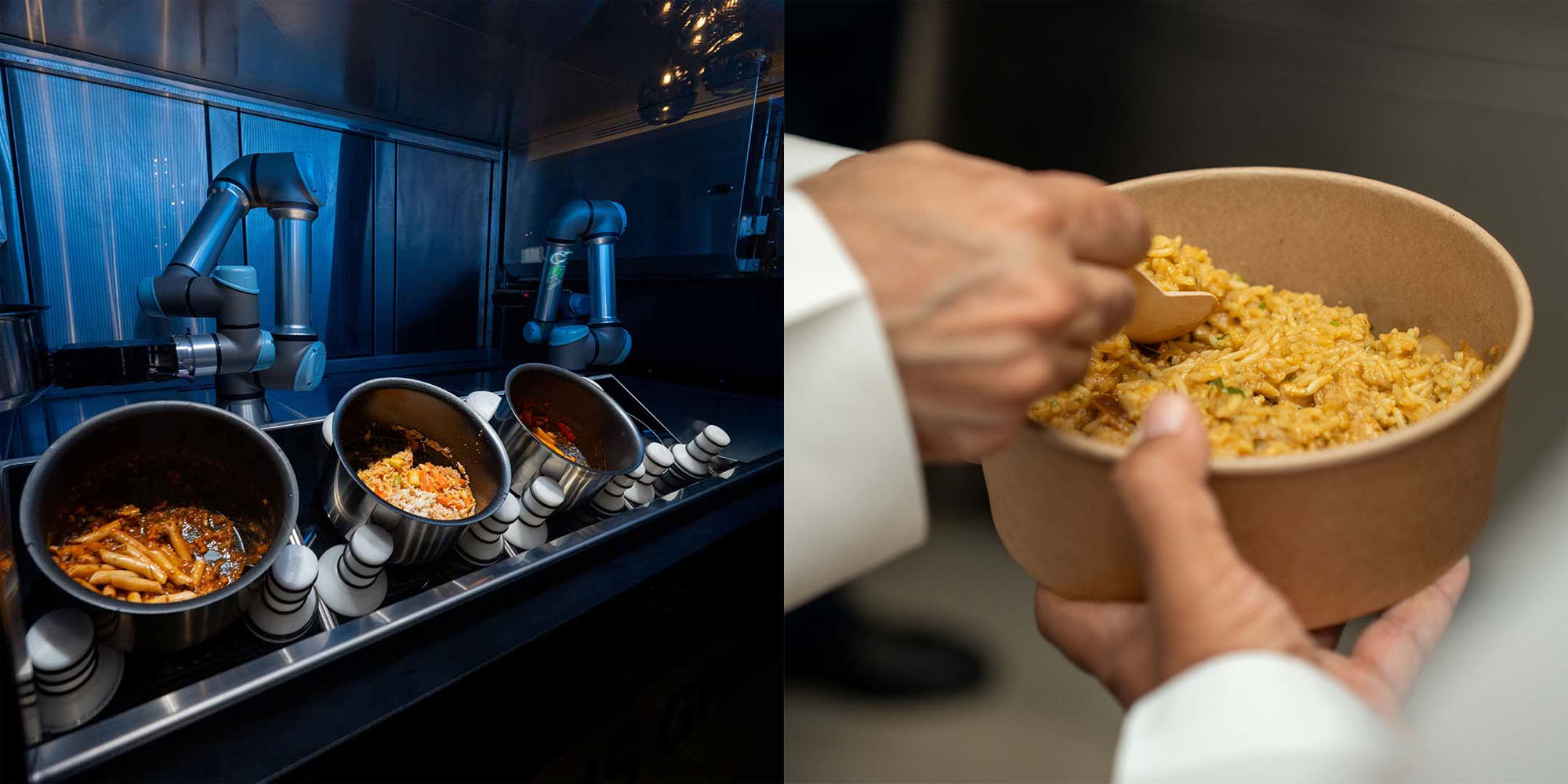
Instead, the CA-1 system is built around pot-based cooking: curries, pastas, soups and rice dishes. After experimenting with highly personalized recipes, Circus deliberately leaned back toward recognizable food. “We’re going with a chicken biryani because you know it,” Bullwinkel says of the AED 40 dish.
The Germany-based robotics and food technology company operates across eight countries, and Abu Dhabi is its first deployment outside Europe. More locations are expected there and in Dubai.
In Germany, its units can be placed in supermarkets, gas stations, airports and hospitals. In the Gulf, Bullwinkel wants them inside residential and office buildings, replacing some of the complexity of last-mile delivery. “We’re basically bringing a very tiny factory a few square meters into your building,” he says. Catering company Royal Prestige supplies the ingredients and knowledge of local tastes.
The CA-1 manages up to 36 refrigerated ingredient silos alongside automated induction cooking, robotic plating and a self-cleaning dishwasher. Two robotic arms move ingredients through the system with minimal human intervention. It can produce up to 120 hot meals an hour, and a meal such as rice and curry can take around three to four minutes.
Also Read: Ooredoo Qatar’s 5G+ Network Is Built For Machines As Much As People
Five cameras and multiple sensors monitor heat, temperature and consistency, an attempt to approximate what a chef perceives. “You can hear something gets burned, you can smell it, you can see it at some point,” Bullwinkel says. CircusOS, the company’s operating system, adjusts recipes in real time.
You might think of the platform as a threat to kitchen staff, but Bullwinkel frames Circus as a way for chefs to develop recipes and distribute them at scale. With that being said, rising labor costs and shortages are also part of his case for automation.

Abu Dhabi’s Robot Kitchen Is Serving Up Biryani, Not Burgers

Sennheiser’s MOMENTUM 5 Series Bets On Batteries You Can Swap

UAE’s 3-Minute University Registration Runs On Government Data

How Online Ads Became A Delivery System For Zero-Click Spyware

Shokz OpenDots 2 Review: Clip-On Audio Gets A Bass-Heavy Makeover

NEOPAY Wants To Follow Merchants Across Channels And Borders

Dubai Says Its Deepfake Detector Needs Just 7 Seconds Of Video

RØDE’s Low-Profile Studio Arm Is Designed To Stay Out Of Shot

New Disney+ Streaming App Has Officially Launched In The UAE

For etisalat, More Bandwidth Is A Matter Of Digital Sovereignty


-
 News3 weeks ago
NEOPAY Wants To Follow Merchants Across Channels And Borders
-
 News2 weeks ago
Dubai Says Its Deepfake Detector Needs Just 7 Seconds Of Video
-
 News3 weeks ago
RØDE’s Low-Profile Studio Arm Is Designed To Stay Out Of Shot
-
 News2 weeks ago
New Disney+ Streaming App Has Officially Launched In The UAE