
News
Dubai’s aradus Wants AI To Run The Back Office Of Physical Trade
The startup says it already automates over 90% of orders and inquiries for MENA manufacturers, leaving humans with only the decisions that matter.


While much of the market is still piloting AI chatbots, a Dubai-based startup called aradus says it is way past that stage. Launched in May 2026, the platform deploys AI agents to handle the operational grind of manufacturers, distributors and importers – the businesses that make and move physical goods rather than software.
The aradus pitch is based around a familiar problem: A distributor’s working day is spread across an ERP, email threads, WhatsApp groups and spreadsheets. Orders arrive in one place, shipping documents in another, and someone has to find the information, re-enter it and chase whatever is missing.
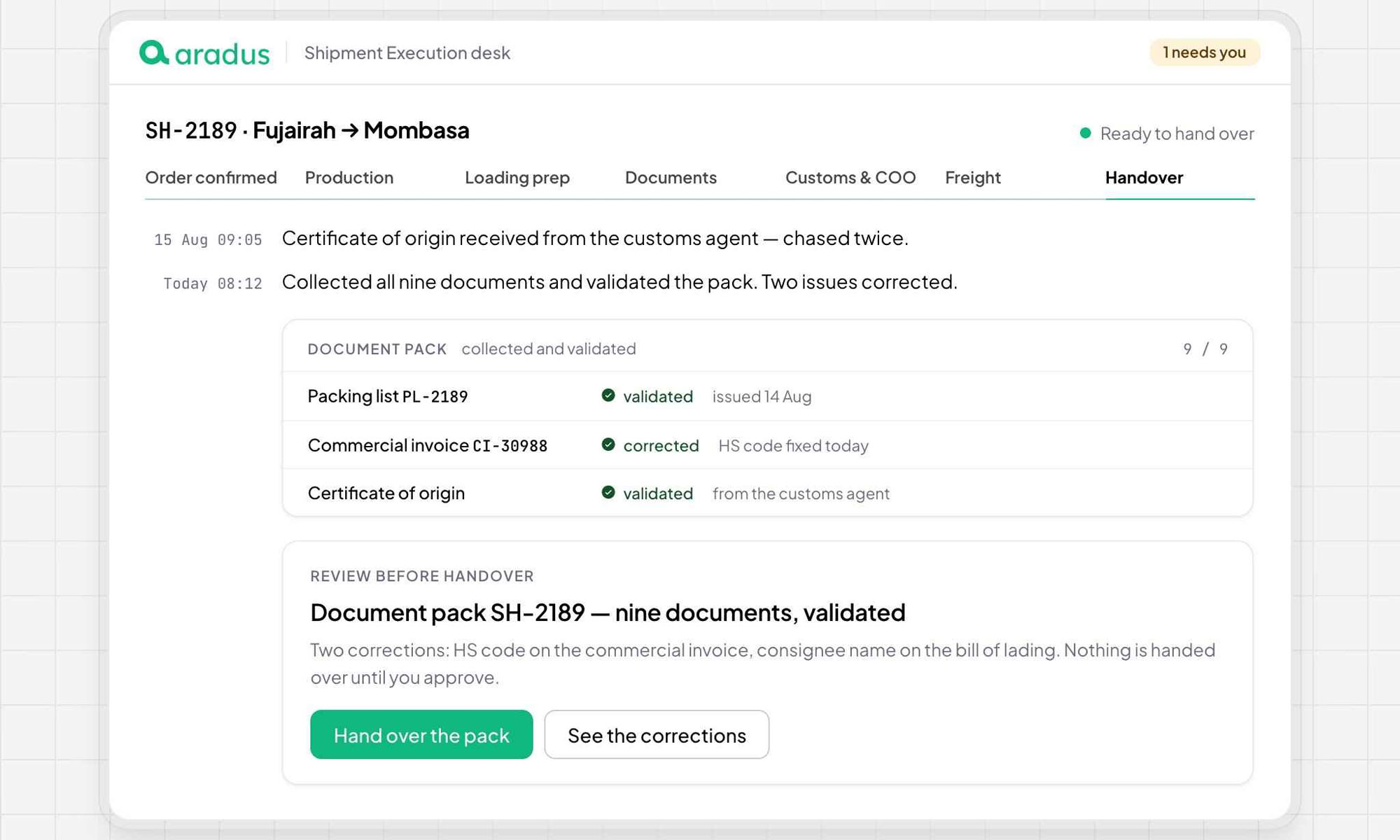
aradus sits on top of those existing systems, whether ERP, TMS or WMS, rather than replacing them. Its agents read and validate incoming documents, manage purchase orders and inventory, track shipments, follow up on missing paperwork, draft routine messages, flag discrepancies and keep records current. When a decision needs a human, the platform routes it to a Command Center with the relevant context and a recommended action already attached. The person approves; the system executes.
Across live customer workflows in the MENA region, aradus says it has automated more than 90% of customer orders and inbound inquiries. Shipment tracking alone, it estimates, avoids USD 100 to 200 in demurrage charges per container – a cost familiar to anyone importing by sea.
Also Read: Qatar Is Getting Its First EV Plant, Built To Cope With Gulf Heat
“Manufacturers and distributors across different sectors deal with thousands of operational tasks to keep the goods moving every day. We built aradus to take the burden off their teams by providing an AI workforce that can execute routine operational tasks across the systems they already rely on daily,” says Karam El Assaad, Co-Founder and CEO of aradus.
Target sectors for aradus include pharma and medical, food and beverage, cosmetics and personal care, electronics, plastics and packaging, auto parts and industrial. The company’s bet is that with humans doing final approvals, its machines can handle everything else.





News
ESET Bets On Specialized Security AI At 0.5% The Training Cost
ESET says NeoCortex can estimate an attacker’s next move, with a kill switch and human oversight built in to keep it from going rogue.

A sign-in anomaly, a suspicious process launch and an unusual connection may look harmless alone. Together, they can describe an intrusion that is hard for security to teams to piece together.
To solve that problem, ESET announced ESET NeoCortex on November 4, 2026: a specialized foundational AI model for cybersecurity. It powers ESET LiveCortex, available within the ESET PROTECT Platform, which connects fragmented security signals and turns them into actionable incidents.
Filtering is the main selling point, with LiveCortex processing billions of raw telemetry events daily, and just 0.00111% of them contributing to incidents presented to customers. The aim is less alert fatigue and more analyst time spent on threats that matter.
NeoCortex is built on world-model architecture, learning how digital environments behave and how events relate. ESET says that lets it reconstruct missing incident context, recognize similar past cases and estimate an attacker’s likely next step – what the company calls “minus-one-day defense,” a chance to intervene before the next stage unfolds. ESET points to Black October, the week leading up to October 25, 2026, when critical security issues affecting PHP, Linux, GitLab and other key systems demanded rapid, prioritized responses, as the kind of moment where that context matters.
ESET’s internal research also suggests a specialized model like NeoCortex can be trained at up to 200 times lower cost than a large general reasoning model, while delivering more accurate, defense-focused results. The company credits optimized training, a focus on cybersecurity vocabulary, lower computing requirements and privately owned hardware.
Also Read: Dubai Says Its Deepfake Detector Needs Just 7 Seconds Of Video
“AI is accelerating both cyberattacks and cyberdefenses. With ESET NeoCortex, we are applying our AI investment to develop specialized foundational cybersecurity intelligence that remains under our control and strengthens, rather than replaces, human expertise,” said Juraj Malcho, Chief Technology Officer at ESET.
As part of the design, NeoCortex forms part of a layered architecture combining specialized models, deterministic controls, correlation logic, validation, auditability and expert human oversight. Safeguards include restricted sandboxes, read-only tools, continuous monitoring, defined usage and token limits, a kill switch and human oversight of critical response decisions. The model is also developed and self-hosted on ESET’s own infrastructure, which the company says reduces exposure to shifts among third-party AI providers, including commercial and geopolitical ones.

ESET Bets On Specialized Security AI At 0.5% The Training Cost

Whish Money Opens A Montreal Flagship To Enter The Canadian Market

Abu Dhabi Is Making Its Rulebook Readable To AI, With OpenAI

Binance Reportedly Loses $6.3 Billion In Record Crypto Heist

Robinhood Receives Approval To Launch In The Middle East

G42’s Inception42 Wants AI To Show Its Work Before Investors Commit

Abu Dhabi’s Robot Kitchen Is Serving Up Biryani, Not Burgers

Shokz OpenDots 2 Review: Clip-On Audio Gets A Bass-Heavy Makeover

WHOOP Goes Arabic, Betting On The Gulf’s Appetite For Health Data

Sennheiser’s MOMENTUM 5 Series Bets On Batteries You Can Swap


-
 News3 weeks ago
Abu Dhabi’s Robot Kitchen Is Serving Up Biryani, Not Burgers
-
 Product Reviews3 weeks ago
Shokz OpenDots 2 Review: Clip-On Audio Gets A Bass-Heavy Makeover
-
 News3 weeks ago
Sennheiser’s MOMENTUM 5 Series Bets On Batteries You Can Swap
-
 News2 weeks ago
Checkout.com Reports 20% Higher Payment Acceptance For PRYPCO