
News
Dubai Turns AI On Its Own Civil Service To Measure Productivity
Five years and millions of data points in, a single framework now tracks how 32 government entities use their people and their money.


Governments have always been obsessed with what they spend. However, Dubai is now attempting to measure what it gets back.
The emirate has deployed a unified Workforce Productivity Measurement System across 32 government entities that’s built on machine learning and advanced artificial intelligence. Formally adopted as a government-wide framework under Executive Council Resolution No. 67 of 2025, it gives every participating department the same method for analyzing the relationship between human and financial resources, government outputs and service outcomes.
The Dubai Government Human Resources Department (DGHR) says the system took five years to develop and draws on millions of data points. Its analytical tools and digital platforms allow entities to monitor productivity indicators and assess how resources are being used, with the resulting data intended to sharpen planning, lift institutional performance and hand policymakers more accurate, forward-looking insight.
The rollout was gradual, with work beginning in 2020 with a pilot across a limited number of entities. Resolution No. 7 of 2023 created the Workforce Productivity Measurement Steering Committee to help develop the methodology and ready departments for wider adoption. With the system now government-wide, that committee has concluded its work.
Also Read: Qatar Airways Flies The World’s First Starlink-Equipped 787-9
“The adoption of the Workforce Productivity Measurement System across the Government of Dubai represents a strategic milestone in the advancement of government work and reflects Dubai’s vision to build a government driven by data and advanced analytics,” says Abdullah Ali Bin Zayed Al Falasi, Director General of DGHR. He adds that the system goes beyond measurement, establishing a unified framework to support resource allocation, improve service quality and strengthen institutional performance.
What the announcement does not yet detail is how productivity is defined for a civil service, which indicators the models weigh, or whether measurement stops at the entity level or reaches individual employee desks.




News
alkalma And BeehiveX Team Up To Turn Health Awareness Into Action
The UAE partnership will test what actually gets people to screen early, seek support and keep up healthier habits.


Awareness is only the first step when it comes to health. The harder part is getting people to act on it, and that’s the problem alkalma and BeehiveX have agreed to examine together.
Leaders from the two organizations signed a Memorandum of Understanding (MoU) at Future Health in Abu Dhabi today. The agreement will explore how health programs can better support participation in screening, earlier support-seeking and healthier behaviors. Work will begin in the UAE, with opportunities elsewhere in the region considered jointly.
For Dr. Omar Najim, Chairman, BeehiveX, the gap is clear: “Awareness alone does not change behavior. Real impact comes from understanding people, removing barriers to action and making healthier choices easier”.
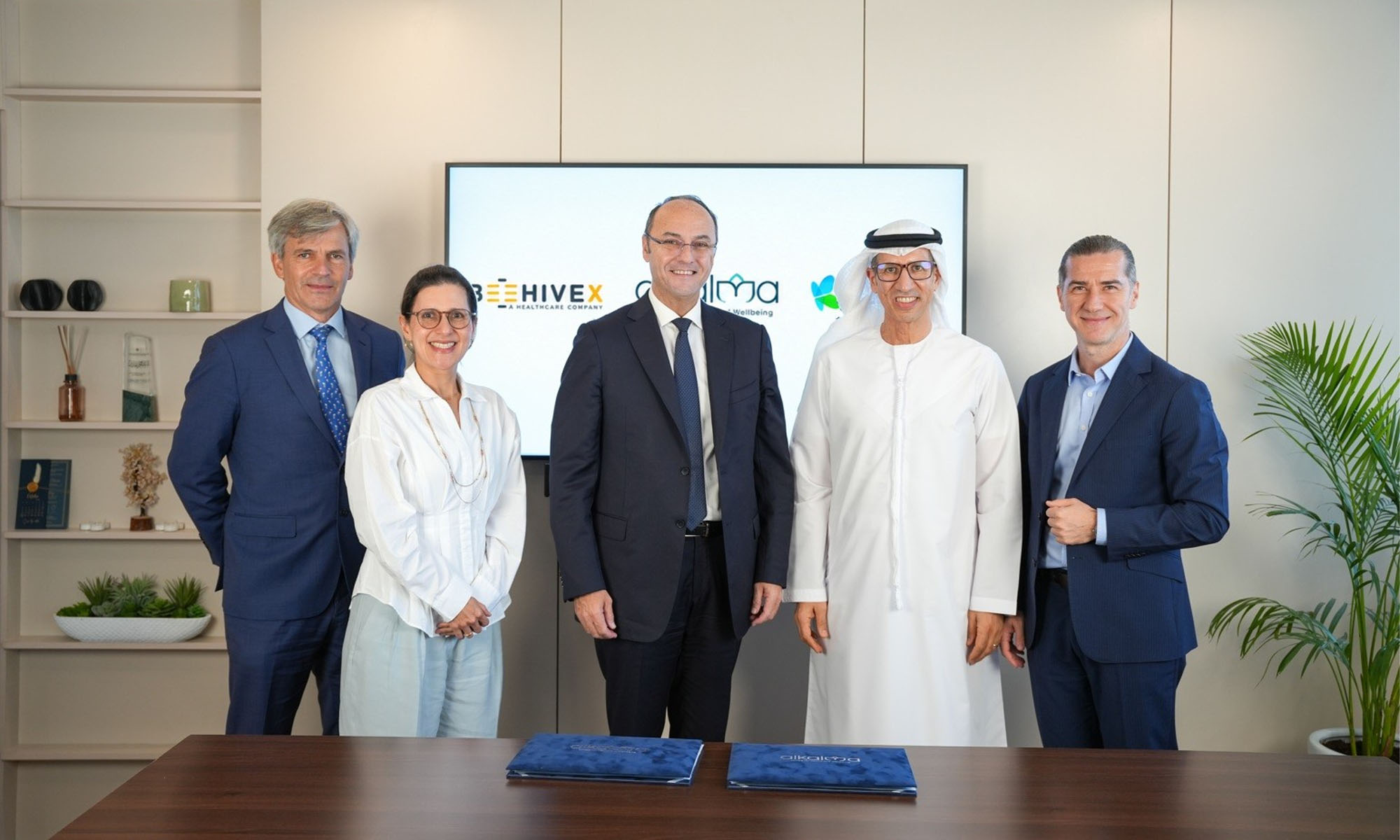
The partners each bring complementary tools. alkalma provides mental health and wellbeing services built on Keralty’s Population Health Management expertise, using it to identify the health needs and risks of different population groups and to run programs focused on prevention, early detection and coordinated care. BeehiveX adds behavioral science, research and communication expertise, studying people’s motivations, the barriers they face and their readiness to change.
The aim is to link how programs are designed with how people actually respond to them. Possible areas of collaboration include community wellbeing initiatives, school and workplace programs, and support for people managing long-term health conditions. The partners will also explore jointly designing, piloting and evaluating behavioral interventions, building evidence on what works and shaping programs that can scale.
Also Read: WHOOP Goes Arabic, Betting On The Gulf’s Appetite For Health Data
Dr. Emilio Herrera, CEO of alkalma and Keralty MENA, said: “A health program needs to do more than identify a risk or explain what someone should do. It also needs to understand their circumstances and help them take the next step”.
In the near future, specific initiatives will be developed and agreed jointly by the two organizations.

alkalma And BeehiveX Team Up To Turn Health Awareness Into Action

Mastercard And LiaPay Bring Earned Wage Access To GCC Workers

Dubai Residential Lets Tenants Break Up First Rent Installment

ESET Bets On Specialized Security AI At 0.5% The Training Cost

Whish Money Opens A Montreal Flagship To Enter The Canadian Market

Checkout.com Reports 20% Higher Payment Acceptance For PRYPCO

Apple Acknowledges iPhone Duo Display Issue After Viral Reports

Dubai Doubles Its AI Campus Target To 1,000 Companies By 2030

Robinhood Receives Approval To Launch In The Middle East

Binance Reportedly Loses $6.3 Billion In Record Crypto Heist


-
 News4 weeks ago
Checkout.com Reports 20% Higher Payment Acceptance For PRYPCO
-
 News3 weeks ago
Apple Acknowledges iPhone Duo Display Issue After Viral Reports
-
 News3 weeks ago
Dubai Doubles Its AI Campus Target To 1,000 Companies By 2030
-
 News3 weeks ago
Robinhood Receives Approval To Launch In The Middle East