
News
RØDE’s New DS3 Studio Arm Is Built For Heavier Creator Setups
A weighted base, a near-silent ball head, and a 1.5kg payload: RØDE’s latest arm is aimed at desks that keep getting more crowded.

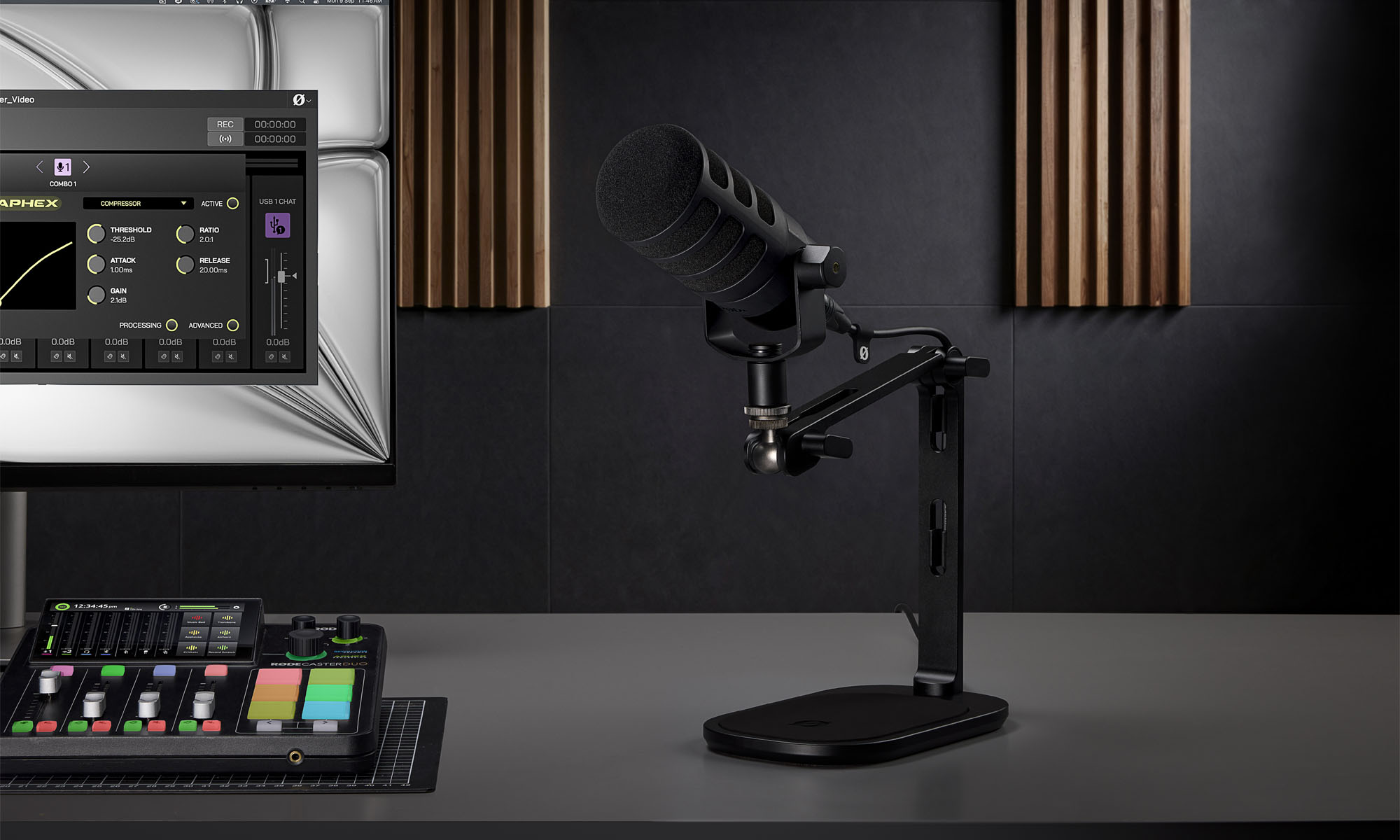
The desktop microphone arm has become one of the most crowded pieces of real estate in the home studio. As podcasters and streamers pile on broadcast microphones, cameras and lights, the humble boom has to hold more weight, move more quietly and take up less space. RØDE’s answer, announced yesterday in Sydney, is the DS3.
The Australian audio company positions the DS3 as the next generation of its professional desktop studio arm, succeeding the DS2. The headline feature is capacity: a 1.5kg payload rated for heavier equipment, from broadcast-grade XLR microphones such as RØDE’s own PodMic to other large-diaphragm microphones, cameras, lights and accessories.
The more interesting engineering is in the integrated ball head, which is designed to deliver smooth, controlled and virtually silent positioning. The result is that presenters can nudge a microphone mid-broadcast without the creak that betrays a cheaper arm. A central locking mechanism fixes the equipment at the chosen angle in a single motion.
RØDE has kept the design choice that distinguished the DS2: a weighted base rather than a desk clamp. That means the arm can sit anywhere on a flat surface rather than being tethered to an edge, and the company says the redesigned base delivers greater stability for heavier setups with no wobble or risk of tipping, while keeping a compact footprint.
Also Read: Anghami’s New Elite Program Starts With A Three-Decade Catalog
Each finish gets its own acoustic isolation pad, intended to dampen vibration as much as to look good. The Classic Black version uses a soft-touch silicone pad inlaid on and beneath the base; the Crisp White version uses natural cork on both sides. Cable clips route XLR and USB cables out of sight, and the box includes 3/8″, 1/4″ and 5/8″ thread adapters, so most microphones, cameras and lights should mount without an extra purchase.
The DS3 is available now in black for US$109 with shipping worldwide. The white finish, which retails at the same price, is coming soon.




News
New Disney+ Streaming App Has Officially Launched In The UAE
The app’s recommendations now factor in what’s popular in the UAE, and a dedicated Junior Mode gives kids their own corner of Disney+.


A new Disney+ app has officially launched in the UAE, and subscribers can now keep watching their favorite titles when they travel. Disney+ says access extends across supported markets in Europe, the United States and beyond.
The app is built around a dynamic homepage and simpler navigation, with recommendations drawn from each customer’s viewing habits and what’s popular in the UAE. Content from Hulu and ESPN is now easier to find alongside Disney+’s own library, the company says. Audio and subtitles come in up to 25 languages, and supported devices get high-quality video and sound.
For families, the app includes Junior Mode, a dedicated, simplified version of Disney+ for younger viewers, built around age-appropriate shows and movies. It sits alongside existing controls such as PIN-protected profiles, customizable content ratings and account notifications when a profile is changed.
The catalog still spans Disney, Pixar, Marvel, Star Wars, National Geographic, Hulu and FX. Returning series include Season 8 of “The Kardashians,” Season 23 of “Grey’s Anatomy” and Season 38 of “The Simpsons”. Also on the service are the second season of International Emmy and BAFTA Award-winning series “Rivals,” comedy “Only Murders in the Building,” Walt Disney Animation Studios’ “Zootropolis 2” and 20th Century Studios’ “Send Help”.
Also Read: Best Video Streaming Services In The Middle East
Marvel Television’s “VisionQuest” is on the way, and Disney’s live-action “Moana” is due later this autumn. Beyond Hollywood, the Turkish title “Halef” is coming to the platform alongside a lineup of Korean entertainment: Korean-Japanese romantic comedy “Merry Berry Love” is streaming now, and “The Remarried Empress” arrives November 4.
Existing subscribers will be prompted to download the new app and sign in with their current credentials, with on-screen steps covering account confirmation and profile setup. Subscriptions start at AED 49.99 per month and can be canceled at any time.
For UAE subscribers planning to travel, the update will likely be well received, but Disney has left one question open. It confirms Europe and the United States as supported markets but doesn’t yet say which others fall under and beyond.

New Disney+ Streaming App Has Officially Launched In The UAE

Dubai Says Its Deepfake Detector Needs Just 7 Seconds Of Video

OpenAI Has Announced A Visual Ad Format For ChatGPT

For etisalat, More Bandwidth Is A Matter Of Digital Sovereignty

NEOPAY Wants To Follow Merchants Across Channels And Borders

Trip.com Is Betting An AI Agent Will Book Your Next Vacation

Musk’s Boring Company Wants To Dig 150 KM Of Tunnel Under The UAE

OKX Bets Streaming Perks Can Take Crypto Mainstream Across MENA

Meta’s New $499 Plan Puts A Price On Reaching A Real Person

Qatar Folds 45 State Companies Into A Single Investment Platform


-
 News3 weeks ago
Qatar Folds 45 State Companies Into A Single Investment Platform
-

 News3 weeks ago
Microsoft Plans $10 Billion-Plus Gulf Expansion Despite Iran Conflict
-

 News3 weeks ago
In Kuwait, Your Surgeon Might Be Operating From Another Country
-
 News1 week ago
NEOPAY Wants To Follow Merchants Across Channels And Borders