
News
AltoVolo Opens Orders For Limited Edition Sigma eVTOLs
Early buyers can now reserve build slots for AltoVolo’s 500-mile hybrid aircraft through a new online configurator.


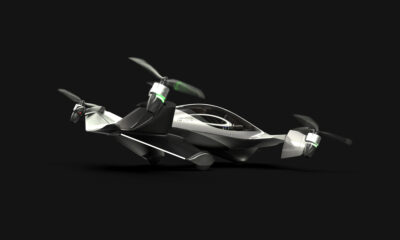
AltoVolo has started taking pre-orders for its first electric vertical take-off and landing aircraft, the Sigma, moving the startup closer to commercial rollout. Customers can now secure a build slot with a £860 deposit and customize every detail online — from paintwork to seatbelt stitching. It’s the first configurator of its kind for a civilian eVTOL, mirroring how luxury car brands let clients tailor performance models before production.
The Sigma runs on a hybrid-electric tilting jet system built for long range and low noise. It can travel up to 500 miles at a 220-mph cruise, and is over 80% quieter than a helicopter. The three-seater weighs just 980kg and can maintain stable flight even if one jet fails. Safety systems include triple-redundant controls, thrust-vectoring stability and a ballistic parachute.
“We will be delivering an ultra-refined hybrid electric aircraft,” said founder and CEO Will Wood. “We believe there are thousands of customers for this type of cutting-edge technology”.
The first 100 units will come with exclusive materials and finishes. AltoVolo is also setting up a global service and maintenance network, with early planning for overhaul schedules already underway. The company’s focus on ownership experience echoes its ambition to anchor itself alongside established aviation brands rather than pure tech ventures.
To help new owners train, the company has built a full-scale simulator that replicates the Sigma cockpit in carbon fiber and leather. Pilots can log time toward a license using the system, aligned with the new US MOSAIC rules that ease certification for powered-lift aircraft. Certification work in Europe and the UK continues in parallel, signaling growing international alignment around light sport and eVTOL regulation.
Also Read: Snapchat Opens Qatar Office To Deepen Gulf Presence
Noise inside the cabin has become another design focus. Engineers are refining internal vibration levels and developing a responsive soundscape that shifts with each jet’s power load — part feedback, part theatre.
Urban air mobility projects across the Gulf and elsewhere are pushing regulators and manufacturers to meet in the middle. Dubai, Riyadh and Doha have each outlined plans for air taxi corridors this decade. AltoVolo’s hybrid Sigma, sitting between electric promise and aviation realism, looks built for that middle ground.





News
Meta’s New AI Tool Builds Images From Public Instagram Photos
Muse Image lets anyone generate AI visuals from your public posts, unless you find the opt-out that’s buried in your account settings.

Meta has a new AI image generator, and it comes with a feature that has privacy advocates alarmed. Muse Image, launched Tuesday by the company’s Superintelligence Labs division, lets users generate AI images by @ mentioning any public Instagram account — pulling that person’s photos into the creation without their knowledge.
The tool is available through the Meta AI app, WhatsApp, and Instagram Stories. Meta says it “uses advanced reasoning to understand complex prompts, seamlessly blending multiple photos into high-quality creations you can download and share anywhere”. The tagging is the flashpoint: “Tagging a username lets Meta AI use public photos to build a visual that’s ready to post,” the company says. Every public Instagram profile can be used unless its owner has explicitly opted out.
That default has drawn sharp criticism. Public Citizen, the consumer advocacy nonprofit, called the feature “an egregious invasion of user privacy”. “Meta has once again chosen the creepiest possible path,” said J.B. Branch, the group’s director of federal AI governance and technology policy. “People should not wake up to discover their face has become raw material for someone else’s AI experiment”. “Instead of asking for meaningful consent, Meta quietly defaults users into the system and buries the opt-out in account settings,” Branch added. “It’s a playbook we’ve come to expect from a company with a long history of putting its business interests ahead of the public”.
Also Read: WhatsApp Usernames Are Coming: Here’s How To Claim Yours
Despite the concerns, it’s worth noting that private accounts are already protected. Muse Image requires access to public photos, and anyone trying to tag a private profile will be told the account can’t be used. Public accounts, on the other hand, must opt out manually. To do that, users will need to go to their profile, tap the menu in the top-right corner, then Sharing and Reuse. Under “Allow people to reuse your content on Instagram and with AI features at Meta,” you’ll find separate toggles for Posts and Reels — switch both off to keep your images and videos out of other people’s AI creations.

Meta’s New AI Tool Builds Images From Public Instagram Photos

Tamper With The Recording LED & Meta’s Glasses Kill Camera

Samsung’s Next Unpacked Could Bring Two Galaxy Z Fold 8 Models

OpenAI Cleared To Launch GPT-5.6 Publicly After Government Review

Dubai Certifies The World’s First Purpose-Built Air Taxi Vertiport

Instagram Now Lets You Tune Its Algorithm, But There’s One Big Catch

Deezer’s Free AI Detector Reveals What’s Hiding In Your Playlists

Max Fashion Brings AI Virtual Try-Ons To Gulf Online Shoppers

Logitech’s New Folding Mouse Is Designed For Work On The Go

LUVED Is A New Curated Preloved Marketplace For The UAE


-
 News2 months ago
DJI Teases Dual-Camera Osmo Pocket 4P For 2026 Launch
-

 Web32 months ago
2026 Crypto Trends: Bitcoin, ETFs & The Future Of Payments
-

 News2 months ago
Lebanon Ministers Meet Visa Over National Digital Payment Platform
-
 News2 months ago
At I/O 2026, Sundar Pichai Concedes AI Must Deliver Real Value