
News
RØDE Unveils Wireless Micro Camera Kit For Hybrid Shooters
The new kit brings camera connectivity to the Australian audio company’s compact wireless mic line.


RØDE has launched the Wireless Micro Camera Kit, adding universal camera support to its popular pocket-sized microphone range.
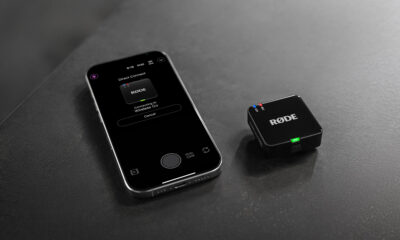
The system builds on the Wireless Micro, which reshaped smartphone content recording, and brings the same audio quality to mirrorless and DSLR setups. The new on-camera receiver carries both 3.5 mm TRS and USB-C outputs, plus a 1.1-inch AMOLED screen for quick visual control. Intelligent GainAssist automatically levels audio, while plug-in power detection turns the receiver on and off with the camera.
Each kit includes two transmitters with in-built microphones, a USB-C smartphone receiver, and a compact charging case offering up to 21 hours of operation. The transmitters clip or mount magnetically, and integrated windshields cut noise during outdoor shoots. For mobile workflows, iOS users can connect via Bluetooth through the RØDE Capture app.

“The Wireless Micro Camera Kit represents the next evolution of our mission to make premium audio accessible to all creators,” said RØDE CEO Damien Wilson. “By expanding the Wireless Micro’s capabilities to include universal camera connectivity, we’ve created a consolidated creative solution that’s not only more powerful, but incredibly flexible and simple to use. No matter how or where you create, the Camera Kit empowers you to tell your story with pristine sound, any way you decide to deliver it”.
Also Read: RobyCam Stadium To Debut In MENA Under New Broadcast Deal
The Camera Kit marks RØDE’s second-generation camera receiver, a follow-up to the original platform that helped define the company’s wireless range. The first generation remains available for existing users through an exchange program.
Priced at US$149, the new kit ships globally. It reinforces RØDE’s position in the creator hardware market, now crowded with brands chasing hybrid video makers. In the MENA region, where digital production and social media video continue to expand under national digitalization drives, such flexible tools are fast becoming part of the basic creative toolkit.





News
New Disney+ Streaming App Has Officially Launched In The UAE
The app’s recommendations now factor in what’s popular in the UAE, and a dedicated Junior Mode gives kids their own corner of Disney+.


A new Disney+ app has officially launched in the UAE, and subscribers can now keep watching their favorite titles when they travel. Disney+ says access extends across supported markets in Europe, the United States and beyond.
The app is built around a dynamic homepage and simpler navigation, with recommendations drawn from each customer’s viewing habits and what’s popular in the UAE. Content from Hulu and ESPN is now easier to find alongside Disney+’s own library, the company says. Audio and subtitles come in up to 25 languages, and supported devices get high-quality video and sound.
For families, the app includes Junior Mode, a dedicated, simplified version of Disney+ for younger viewers, built around age-appropriate shows and movies. It sits alongside existing controls such as PIN-protected profiles, customizable content ratings and account notifications when a profile is changed.
The catalog still spans Disney, Pixar, Marvel, Star Wars, National Geographic, Hulu and FX. Returning series include Season 8 of “The Kardashians,” Season 23 of “Grey’s Anatomy” and Season 38 of “The Simpsons”. Also on the service are the second season of International Emmy and BAFTA Award-winning series “Rivals,” comedy “Only Murders in the Building,” Walt Disney Animation Studios’ “Zootropolis 2” and 20th Century Studios’ “Send Help”.
Also Read: Best Video Streaming Services In The Middle East
Marvel Television’s “VisionQuest” is on the way, and Disney’s live-action “Moana” is due later this autumn. Beyond Hollywood, the Turkish title “Halef” is coming to the platform alongside a lineup of Korean entertainment: Korean-Japanese romantic comedy “Merry Berry Love” is streaming now, and “The Remarried Empress” arrives November 4.
Existing subscribers will be prompted to download the new app and sign in with their current credentials, with on-screen steps covering account confirmation and profile setup. Subscriptions start at AED 49.99 per month and can be canceled at any time.
For UAE subscribers planning to travel, the update will likely be well received, but Disney has left one question open. It confirms Europe and the United States as supported markets but doesn’t yet say which others fall under and beyond.

New Disney+ Streaming App Has Officially Launched In The UAE

Dubai Says Its Deepfake Detector Needs Just 7 Seconds Of Video

OpenAI Has Announced A Visual Ad Format For ChatGPT

For etisalat, More Bandwidth Is A Matter Of Digital Sovereignty

NEOPAY Wants To Follow Merchants Across Channels And Borders

Trip.com Is Betting An AI Agent Will Book Your Next Vacation

Musk’s Boring Company Wants To Dig 150 KM Of Tunnel Under The UAE

OKX Bets Streaming Perks Can Take Crypto Mainstream Across MENA

Meta’s New $499 Plan Puts A Price On Reaching A Real Person

Apple’s First Folding iPhone Arrives Late To A Shrinking Market


-
 News3 weeks ago
Trip.com Is Betting An AI Agent Will Book Your Next Vacation
-
 News4 weeks ago
Musk’s Boring Company Wants To Dig 150 KM Of Tunnel Under The UAE
-
 News3 weeks ago
OKX Bets Streaming Perks Can Take Crypto Mainstream Across MENA
-
 News3 weeks ago
Meta’s New $499 Plan Puts A Price On Reaching A Real Person