
News
Anthropic’s Claude 3.7 Sonnet Introduces Hybrid Reasoning
The latest model lets users choose between rapid responses or slower, but more methodical, step-by-step answers.

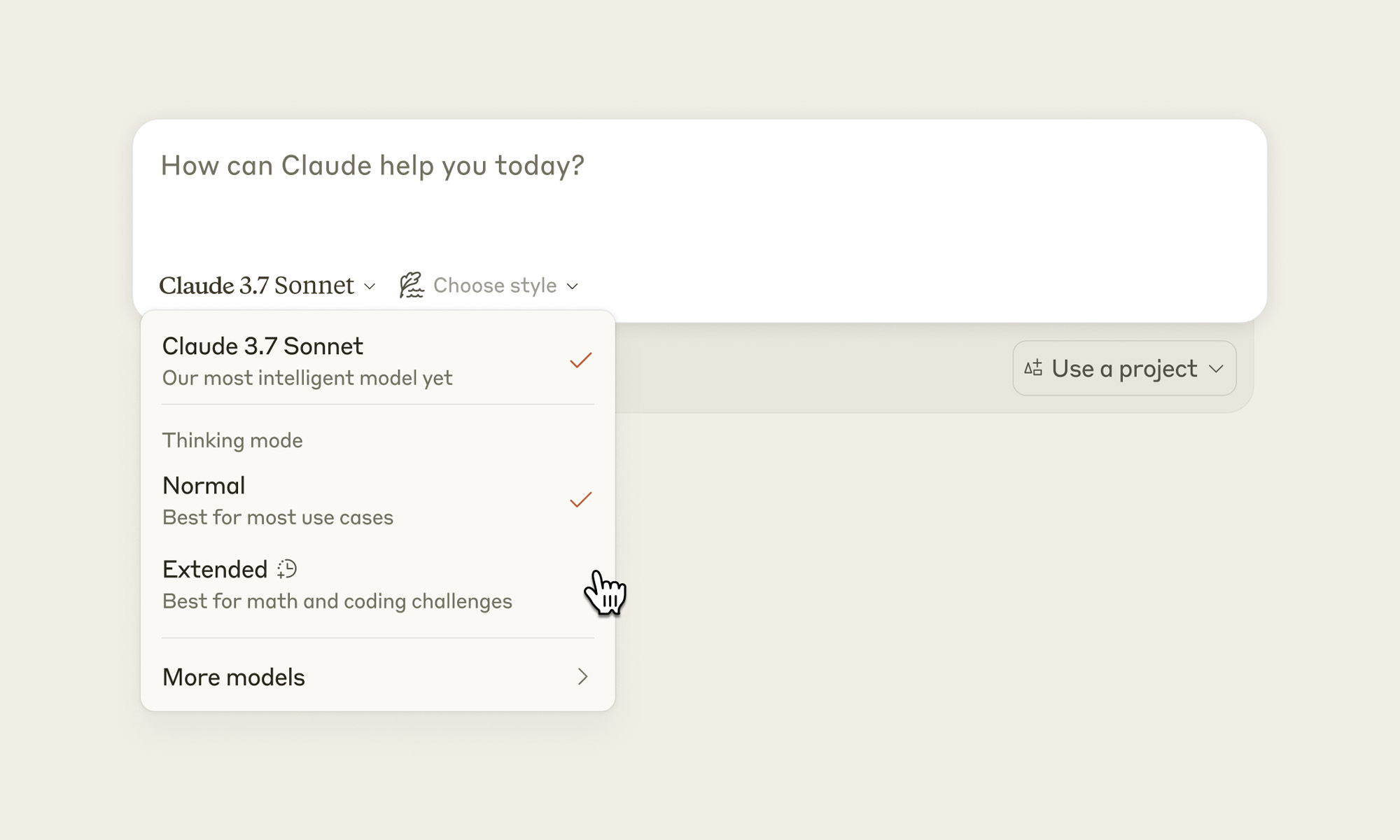
After an exciting start to 2025 with the release of DeepSeek’s Chatbot, it’s now Anthropic’s turn to unveil its latest AI model — Claude 3.7 Sonnet. The new tool is designed to strike a balance between speed and deeper responses, and is being marketed as the first hybrid reasoning model. Claude now gives users the option to choose between rapid responses or a more methodical, step-by-step approach, using a simple dropdown menu to let you decide how queries should be processed.
“We’ve developed Claude 3.7 Sonnet with a different philosophy from other reasoning models on the market. Just as humans use a single brain for both quick responses and deep reflection, we believe reasoning should be an integrated capability of frontier models rather than a separate model entirely,” Anthropic explains. “This unified approach also creates a more seamless experience for users”.
While Anthropic doesn’t call out OpenAI directly, the comparison is hard to ignore. OpenAI currently offers multiple models — GPT-4, o1, o1-mini, and o3-mini — creating a somewhat fragmented experience. Even OpenAI CEO Sam Altman recently acknowledged this issue, posting on X, “We hate the model picker as much as you do and want to return to magic unified intelligence”.
Claude 3.7 Sonnet was also developed with a different focus in mind: Rather than prioritizing high-stakes math and coding challenges, Anthropic aimed to optimize real-world applications. According to the company, users will see notable improvements in areas like coding and front-end web development, reflecting how businesses and developers actually engage with AI.
Also Read: Top Free AI Chatbots Available In The Middle East
The new model is available starting today across all Claude plans, including Anthropic’s free tier. Developers can also access it through Anthropic’s API, Amazon Bedrock, and Google Cloud’s Vertex AI.
Additionally, Anthropic is also rolling out a new tool called Claude Code, designed to streamline software development. This “agentic” system, currently in limited research preview, allows developers to assign coding tasks directly to Claude via a terminal interface. It can read and edit code, run tests, and even push commits to GitHub — offering a glimpse into a more automated, AI-assisted workflow.




News
New Disney+ Streaming App Has Officially Launched In The UAE
The app’s recommendations now factor in what’s popular in the UAE, and a dedicated Junior Mode gives kids their own corner of Disney+.


A new Disney+ app has officially launched in the UAE, and subscribers can now keep watching their favorite titles when they travel. Disney+ says access extends across supported markets in Europe, the United States and beyond.
The app is built around a dynamic homepage and simpler navigation, with recommendations drawn from each customer’s viewing habits and what’s popular in the UAE. Content from Hulu and ESPN is now easier to find alongside Disney+’s own library, the company says. Audio and subtitles come in up to 25 languages, and supported devices get high-quality video and sound.
For families, the app includes Junior Mode, a dedicated, simplified version of Disney+ for younger viewers, built around age-appropriate shows and movies. It sits alongside existing controls such as PIN-protected profiles, customizable content ratings and account notifications when a profile is changed.
The catalog still spans Disney, Pixar, Marvel, Star Wars, National Geographic, Hulu and FX. Returning series include Season 8 of “The Kardashians,” Season 23 of “Grey’s Anatomy” and Season 38 of “The Simpsons”. Also on the service are the second season of International Emmy and BAFTA Award-winning series “Rivals,” comedy “Only Murders in the Building,” Walt Disney Animation Studios’ “Zootropolis 2” and 20th Century Studios’ “Send Help”.
Also Read: Best Video Streaming Services In The Middle East
Marvel Television’s “VisionQuest” is on the way, and Disney’s live-action “Moana” is due later this autumn. Beyond Hollywood, the Turkish title “Halef” is coming to the platform alongside a lineup of Korean entertainment: Korean-Japanese romantic comedy “Merry Berry Love” is streaming now, and “The Remarried Empress” arrives November 4.
Existing subscribers will be prompted to download the new app and sign in with their current credentials, with on-screen steps covering account confirmation and profile setup. Subscriptions start at AED 49.99 per month and can be canceled at any time.
For UAE subscribers planning to travel, the update will likely be well received, but Disney has left one question open. It confirms Europe and the United States as supported markets but doesn’t yet say which others fall under and beyond.

New Disney+ Streaming App Has Officially Launched In The UAE

Dubai Says Its Deepfake Detector Needs Just 7 Seconds Of Video

OpenAI Has Announced A Visual Ad Format For ChatGPT

For etisalat, More Bandwidth Is A Matter Of Digital Sovereignty

NEOPAY Wants To Follow Merchants Across Channels And Borders

Trip.com Is Betting An AI Agent Will Book Your Next Vacation

Musk’s Boring Company Wants To Dig 150 KM Of Tunnel Under The UAE

OKX Bets Streaming Perks Can Take Crypto Mainstream Across MENA

Meta’s New $499 Plan Puts A Price On Reaching A Real Person

Apple’s First Folding iPhone Arrives Late To A Shrinking Market


-
 News3 weeks ago
Trip.com Is Betting An AI Agent Will Book Your Next Vacation
-
 News4 weeks ago
Musk’s Boring Company Wants To Dig 150 KM Of Tunnel Under The UAE
-
 News3 weeks ago
OKX Bets Streaming Perks Can Take Crypto Mainstream Across MENA
-
 News3 weeks ago
Meta’s New $499 Plan Puts A Price On Reaching A Real Person