News
Dubai Startup Silkhaus Aims For A “Smooth As Silk” Experience
Technology now plays a key role in the Dubai rentals market, helping real estate investors and travelers alike to create unique hospitality experiences.


Dubai-based Silkhaus is a PropTech startup that describes itself as a “technology-first hospitality brand”. The company aims to offer immersive nomadic experiences by “providing business and leisure travelers with a home away from home” and, as the name suggests, convert tedious planning into an experience that’s as smooth as silk.
For readers unfamiliar with the term, PropTech is the application of technology in the real estate sector. It encompasses everything from property management and Airbnb-style bookings to construction and analytics, with features usually accessed through a mobile app.
The global PropTech market value is projected to grow from $18.2 to $86.5 billion by 2032 — a compound annual rate of about 17% — and is primarily driven by nomadic professionals who are happy to relocate for career purposes.
As for Silkhaus, the startup was conceived by strategy consultant Aahan Bhojani, who noticed several issues with his own corporate travel experiences. He now strives to ensure others won’t experience the same frustrations.

“I realized there was something broken about the long-stay travel experience, and finding suitable long-term accommodation options on online travel aggregators was like pulling a needle out of a haystack […] aside from investors purchasing real estate, we have seen a growing interest in the resident population seeking to reside in the UAE. The need for a ‘landing pad’ to accommodate incoming audiences has never been stronger,” says Aahan Bhojani, founder and CEO of Silkhaus.
Also Read: Hotel Cloud Kitchen Startup Matbakhi Launches In Saudi Arabia
Despite a gradually worsening global market, Silkhaus was still able to raise $7.75 million in a seed funding round last month, and is well placed to boost its portfolio of investors and continue with a medium-term expansion strategy.
Over the last few years, big data and cloud technology have transformed consumer experiences in the property sector, positively affecting property owners, tenants, landlords, and brokers alike. Startups like Silkhaus look set to continue this trend, with plans in the works to expand to cities across the Middle East and eventually into South and South-East Asia.



News
NVIDIA Puts GPT-5.5 Codex In Hands Of 10,000 Staff
The chipmaker has significantly expanded OpenAI’s latest model across teams from engineering to HR under tight internal controls.
NVIDIA has started rolling out OpenAI’s GPT-5.5 model through the Codex coding agent to more than 10,000 employees, extending the tool well beyond software teams and into core business functions.
The deployment covers engineering, product, legal, marketing, finance, sales, HR, operations and developer programs. Staff are using Codex for coding, internal research and routine knowledge work as companies test whether AI agents can move from demos to daily use.
GPT-5.5 is running on NVIDIA’s GB200 NVL72 rack-scale systems, linking OpenAI’s newest model directly to the chipmaker’s latest infrastructure push. NVIDIA said the systems cut cost per million tokens by 35 times and raise token output per second per megawatt by 50 times versus earlier generations.
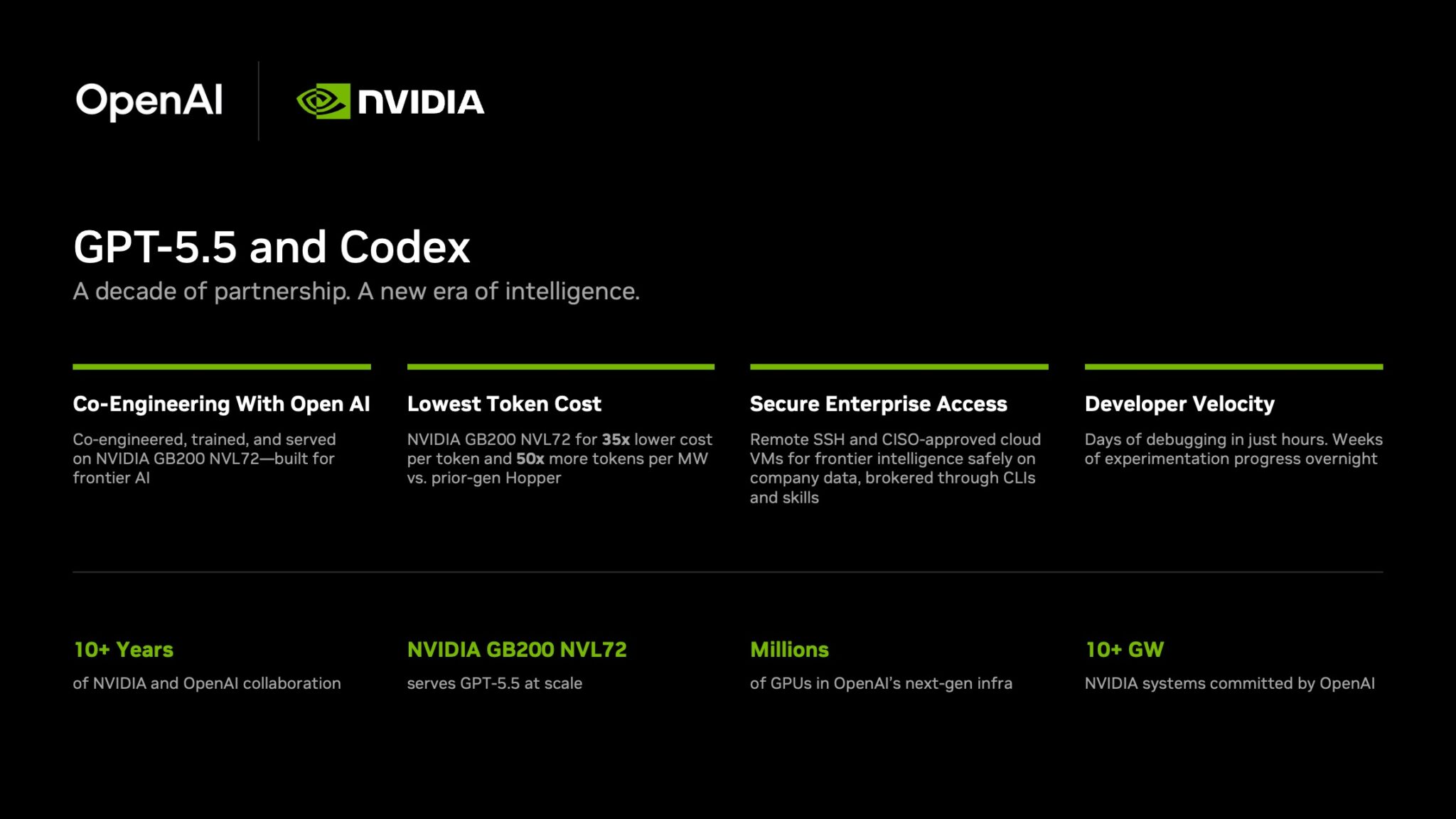
Inside the company, it says the effects are immediate. Debugging work that once took days is being finished in hours and experiments across large codebases that used to stretch over weeks are now handled overnight. Teams are also building features from natural-language prompts with fewer failed runs.
In a company-wide note urging staff to adopt the tool, CEO Jensen Huang wrote: “Let’s jump to lightspeed. Welcome to the age of AI.”
Security remains central to the rollout. Codex can connect through Secure Shell to approved cloud virtual machines, allowing agents to work with company data without moving it outside approved environments. NVIDIA said it assigned cloud VMs to employees so agents run in isolated sandboxes with full audit trails.
Also Read: Deezer Says AI Tracks Now Make Up 44% Of Uploads
The company added that the setup uses a zero-data-retention policy. Access to production systems is read-only through command-line tools and internal automation layers.
The move also highlights NVIDIA’s long relationship with OpenAI. NVIDIA said the partnership began in 2016, when Huang personally delivered the first DGX-1 AI supercomputer to OpenAI’s San Francisco office.
The two companies have since worked across hardware and model deployment. NVIDIA also said OpenAI plans to deploy more than 10 gigawatts of NVIDIA systems for future AI infrastructure.
For Gulf markets pouring money into sovereign AI and enterprise automation, the signal is clear: internal AI agents are moving from pilot phase to standard tooling.

NVIDIA Puts GPT-5.5 Codex In Hands Of 10,000 Staff

Deezer Says AI Tracks Now Make Up 44% Of Uploads

Yango Ride Introduces In-Chat Trip Planning In ChatGPT

Nano Banana 2 Arrives In MENA For Google Gemini Users