
News
Researchers In Abu Dhabi To Receive The Middle East’s First Quantum Computer
A quantum computer doesn’t rely on traditional bits. Instead, it encodes information using qubits, which can have the value of “0” and “1” at the same time.


If there’s one emerging technology capable of single-handedly ushering in a new era of information technology, it’s quantum computing. Soon, researchers working at the Technology Innovation Institute (TII) in Abu Dhabi will get their hands on the Middle East’s first quantum computer, allowing them to solve incredibly complex problems by harnessing the phenomena of quantum mechanics.
“This will put the UAE on the map to be a known entity for research on such a topic. And that’s a big achievement for the entire Arab world,” said Boulos Alfakes, a senior researcher at the TII. “There will be a dramatic difference between the countries that own the technology and the ones that depend on the technology, believes Professor Jose Ignacio Latorre, chief of research at the TII’s Quantum Research Center.
One of the biggest challenges associated with quantum computing is cooling. The small quantum microchip at the heart of the computer is designed to operate at very low temperatures (near absolute zero). If the microchip gets too hot, it becomes unstable, rendering the whole computer useless.
To address this issue, researchers ordered two dilution refrigerators from Finland. The refrigerators are complex and expensive, but less sophisticated cooling methods are not up to the task.
Also Read: Saudi Researchers Use Quantum Computing To Design More Efficient Airplanes
Just like all quantum computers, the one that will soon be in the hands of researchers at the TII doesn’t rely on traditional bits (combinations of zeros and ones). Instead, it encodes information using qubits (or quantum bits), which can have the value of “0” and “1” at the same time.
Thanks to this and other unusual properties, quantum computers can solve certain difficult problems much faster than traditional computers. For example, some cybersecurity experts fear that quantum computing could break traditional cryptography in the near future, potentially forcing millions of organizations around the world to implement quantum-resistant cryptographic algorithms.






News
Samsung And Spotify Offer Free Premium Deal In MENA
Nearly seven in ten streams in the region come from 18-to-34-year-olds — the audience Samsung is hoping to entice into its ecosystem.

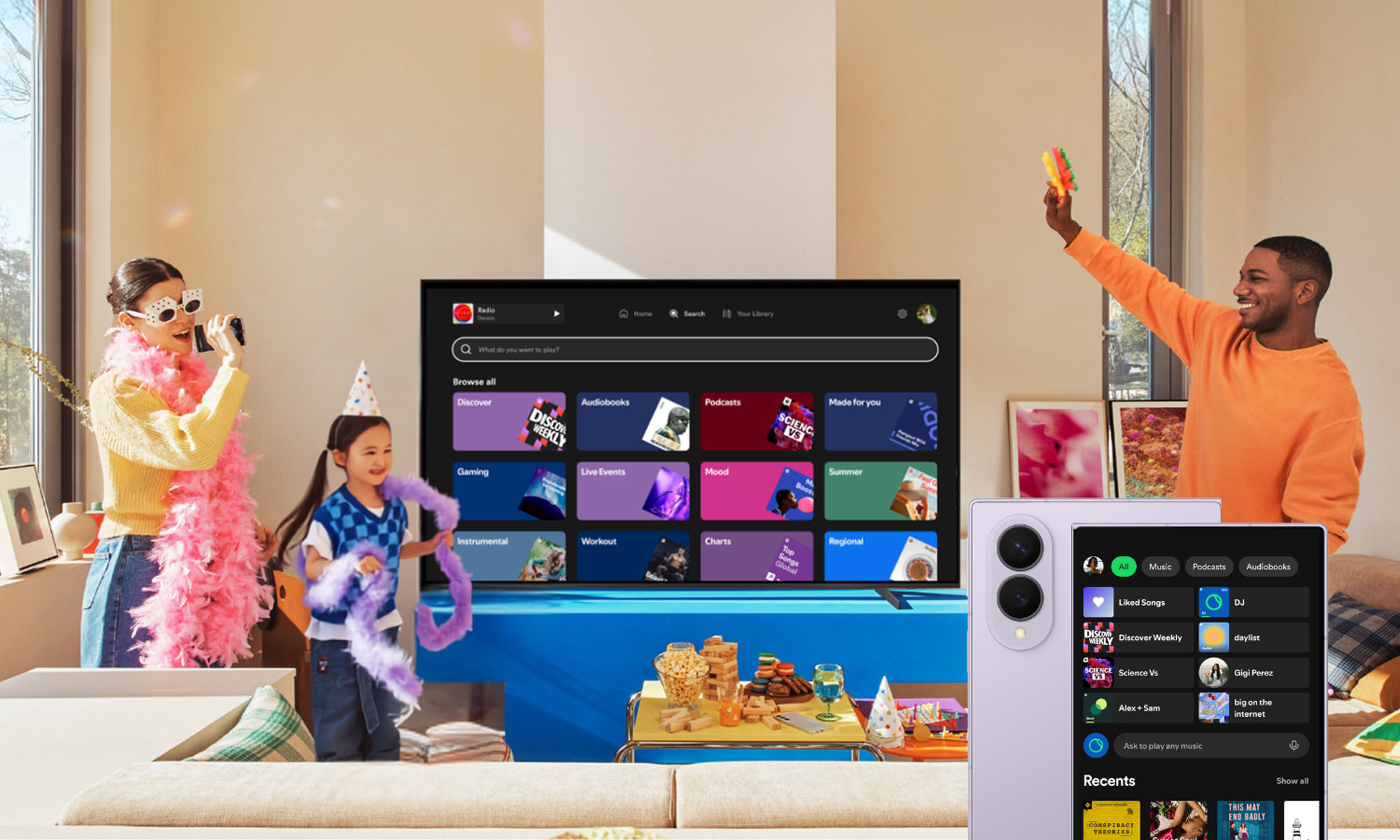
Samsung has announced a partnership with Spotify spanning the Middle East, North Africa, and Türkiye, bundling Spotify Premium with select devices across its ecosystem. The headline offer — up to four months of Premium for free — is a first for the region.
Customers in Saudi Arabia, the UAE, and Türkiye who buy any OLED or 98-inch television, or any Galaxy S or Z series mobile device, get four months of Spotify Premium. The offer, tiered by market and device, is available at retail and on Samsung.com, and redeemed through the Samsung Promotion and Samsung Members apps.
For Samsung, the strategy is less about free music than about lock-in. The Korean tech giant’s pitch is continuity: a track starts on a Galaxy smartphone through Galaxy Buds on the commute, moves to a Samsung TV and soundbar in the living room, and stays controllable from a Galaxy Watch. The more seamlessly music travels between those devices, the harder it becomes to swap any one of them for a rival’s.
“Technology should bring people closer to the things they love, and few things connect people the way music does,” said Omar Saheb, Regional VP of Marketing and Online Business at Samsung Electronics MENA. The partnership, he added, gives customers “a genuine reason to choose Samsung for the experience, not only the product”.
Also Read: Shokz OpenFit Pro Review: Open-Ear Audio Finally Grows Up
For subscribers, Premium brings the usual package: ad-free listening, offline downloads, richer audio quality on Galaxy Buds and Samsung sound devices, and Jam, which lets friends build a shared queue.
“At Spotify, we are always working to make every listening moment feel more personal, meaningful, and worth it,” said Rami Jamal, Head of Partnerships at Spotify for South Asia, Middle East, and Africa.
The demographics go a long way to explaining the strategy. Across MENA, Türkiye, and Pakistan, nearly seven in ten Spotify streams come from listeners aged 18 to 34, according to the company — precisely the audience Samsung wants inside its hardware ecosystem before buying habits harden.

Samsung And Spotify Offer Free Premium Deal In MENA

Lebanon’s 5G Era Begins With 150 Stations And A $1M Budget

Syria Just Got Its First Super App Featuring Built-In Digital Payments

Shokz OpenFit Pro Review: Open-Ear Audio Finally Grows Up

This UAE Platform Wants To Replace Fashion Photo Shoots With AI

TikTok Hopes Labels And Literacy Will Tame AI-Generated Content

Samsung’s Galaxy Watch 9 And Ultra 2 Specs Leak Ahead Of Unpacked

Gulf AI Job Vacancies Nearly Triple, But Hiring Stays Lopsided

Dubai Police Finishes 65 Projects, Says AI Is The Next Priority

Beirut Wins US Flight Access, But Carriers Aren’t Sold Yet


-
 News3 weeks ago
Gulf AI Job Vacancies Nearly Triple, But Hiring Stays Lopsided
-
 News3 weeks ago
Dubai Police Finishes 65 Projects, Says AI Is The Next Priority
-
 News3 weeks ago
Beirut Wins US Flight Access, But Carriers Aren’t Sold Yet
-

 News3 weeks ago
Samsung’s Fold Goes Wide, And The Whole Galaxy Range Gets Pricier