
News
Emirates And Etihad Soar In 2025 Global Airline Safety Ranking
Emirates, Etihad Airways, flydubai, and Air Arabia earn top safety rankings for 2025, positioning UAE airlines among the safest carriers globally.


Safety remains the paramount concern in global aviation, shaping traveler confidence in airlines around the world. In the latest 2025 airline safety rankings by AirlineRatings.com, UAE carriers — including Emirates, Etihad Airways, flydubai, and Air Arabia — have achieved outstanding results, cementing their positions among the safest airlines globally.
AirlineRatings.com evaluated 385 airlines across key safety metrics such as incident records, fleet age, pilot training, fleet size, financial health, and compliance with international safety standards including IOSA and ICAO audits. The UAE airlines’ high rankings underscore the region’s continued commitment to advanced safety protocols, operational excellence, and fleet modernization.
In the closely contested full-service airline category, Air New Zealand edged out Qantas by just 1.50 points to secure first place, thanks to a younger fleet. Emirates tied for third place alongside Cathay Pacific and Qatar Airways, with all three airlines receiving identical high scores across fleet management, pilot skill, safety practices, and incident records.
Etihad Airways, the UAE’s national carrier based in Abu Dhabi, also secured a fifth place position in the full-service category, sharing the spotlight with renowned global airlines like ANA, Virgin Australia, and Korean Air.
In the low-cost carrier segment, flydubai and Air Arabia were recognized among the safest budget airlines worldwide, joining internationally respected brands such as easyJet, Ryanair, Southwest Airlines, and JetBlue Airways.
Also Read: ALJ & Joby Aviation To Bring Electric Air Taxis To Saudi Arabia
Sharon Petersen, CEO of AirlineRatings.com, emphasized the tight competition at the top of the rankings, noting that the difference often comes down to fleet age and operational consistency.
The strong performance by UAE airlines highlights the nation’s strategic investment in aviation infrastructure, rigorous pilot training programs, and adoption of cutting-edge aircraft technology. It also reinforces the UAE’s pivotal role in connecting global air routes and maintaining standards that travelers around the world trust.
As global air travel continues its post-pandemic recovery, passengers choosing UAE carriers can feel reassured by their reputation for world-leading safety and operational excellence.



News
NVIDIA Puts GPT-5.5 Codex In Hands Of 10,000 Staff
The chipmaker has significantly expanded OpenAI’s latest model across teams from engineering to HR under tight internal controls.
NVIDIA has started rolling out OpenAI’s GPT-5.5 model through the Codex coding agent to more than 10,000 employees, extending the tool well beyond software teams and into core business functions.
The deployment covers engineering, product, legal, marketing, finance, sales, HR, operations and developer programs. Staff are using Codex for coding, internal research and routine knowledge work as companies test whether AI agents can move from demos to daily use.
GPT-5.5 is running on NVIDIA’s GB200 NVL72 rack-scale systems, linking OpenAI’s newest model directly to the chipmaker’s latest infrastructure push. NVIDIA said the systems cut cost per million tokens by 35 times and raise token output per second per megawatt by 50 times versus earlier generations.
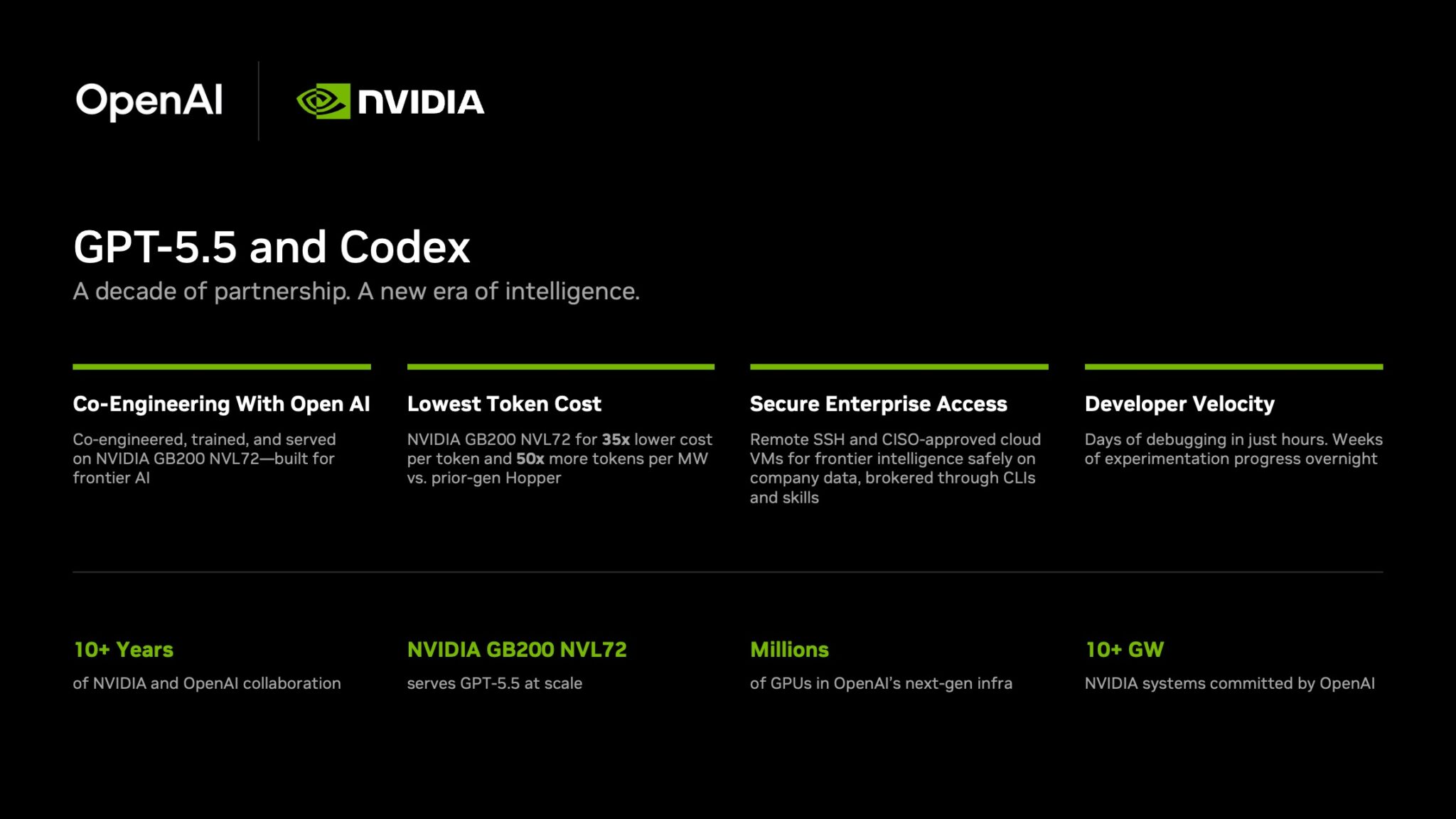
Inside the company, it says the effects are immediate. Debugging work that once took days is being finished in hours and experiments across large codebases that used to stretch over weeks are now handled overnight. Teams are also building features from natural-language prompts with fewer failed runs.
In a company-wide note urging staff to adopt the tool, CEO Jensen Huang wrote: “Let’s jump to lightspeed. Welcome to the age of AI.”
Security remains central to the rollout. Codex can connect through Secure Shell to approved cloud virtual machines, allowing agents to work with company data without moving it outside approved environments. NVIDIA said it assigned cloud VMs to employees so agents run in isolated sandboxes with full audit trails.
Also Read: Deezer Says AI Tracks Now Make Up 44% Of Uploads
The company added that the setup uses a zero-data-retention policy. Access to production systems is read-only through command-line tools and internal automation layers.
The move also highlights NVIDIA’s long relationship with OpenAI. NVIDIA said the partnership began in 2016, when Huang personally delivered the first DGX-1 AI supercomputer to OpenAI’s San Francisco office.
The two companies have since worked across hardware and model deployment. NVIDIA also said OpenAI plans to deploy more than 10 gigawatts of NVIDIA systems for future AI infrastructure.
For Gulf markets pouring money into sovereign AI and enterprise automation, the signal is clear: internal AI agents are moving from pilot phase to standard tooling.

NVIDIA Puts GPT-5.5 Codex In Hands Of 10,000 Staff

Deezer Says AI Tracks Now Make Up 44% Of Uploads

Yango Ride Introduces In-Chat Trip Planning In ChatGPT

Nano Banana 2 Arrives In MENA For Google Gemini Users


