News
Saudi Arabia Set To Invest $1 Trillion In The Real Estate Sector
Backed by a young population and expanding urbanization, the property sector has impressive future growth potential.


S&P Global Ratings, a major US credit rating agency, has forecast sustained market growth for the Kingdom of Saudi Arabia, as $1 trillion is set to be pumped into infrastructure and real estate projects over the coming decade.
As well as a young and growing population, expanding urbanization is a significant reason for S&P’s promising predictions, with at least eight new cities being planned along the Red Sea coast by 2030. During the Distinguished Cities Projects Exhibition in Riyadh, nine agreements worth $533 million were signed by the National Housing Company and other national strategic partners.
Saudi Arabia’s large-scale real estate programs will provide 1.3 million new homes overall, invigorating the business and financial sectors, and pumping money into both commercial and residential building via investments.
Saudi Arabia’s economy has also benefited from government initiatives to attract multinational companies, with tech startups, in particular, gravitating to the Kingdom and boosting the occupancy rates of commercial and office real estate across the region.
Also Read: Metaverse Will Bring $15B Annually To Gulf Economies By 2030
S&P also noted that many new programs had been initiated to scale up local housing and revitalize the financial sector, potentially benefiting commercial real estate across the country. As the tourism sector continues to grow rapidly, even more real estate investment opportunities will present themselves as companies and private individuals seek to relocate to Saudi Arabia.
As well as experiencing a dramatic flourishing of the commercial and residential real estate sectors, Saudi Arabia’s 2030 vision is also bringing a boost to energy, healthcare and the wider digital economy.



News
NVIDIA Puts GPT-5.5 Codex In Hands Of 10,000 Staff
The chipmaker has significantly expanded OpenAI’s latest model across teams from engineering to HR under tight internal controls.
NVIDIA has started rolling out OpenAI’s GPT-5.5 model through the Codex coding agent to more than 10,000 employees, extending the tool well beyond software teams and into core business functions.
The deployment covers engineering, product, legal, marketing, finance, sales, HR, operations and developer programs. Staff are using Codex for coding, internal research and routine knowledge work as companies test whether AI agents can move from demos to daily use.
GPT-5.5 is running on NVIDIA’s GB200 NVL72 rack-scale systems, linking OpenAI’s newest model directly to the chipmaker’s latest infrastructure push. NVIDIA said the systems cut cost per million tokens by 35 times and raise token output per second per megawatt by 50 times versus earlier generations.
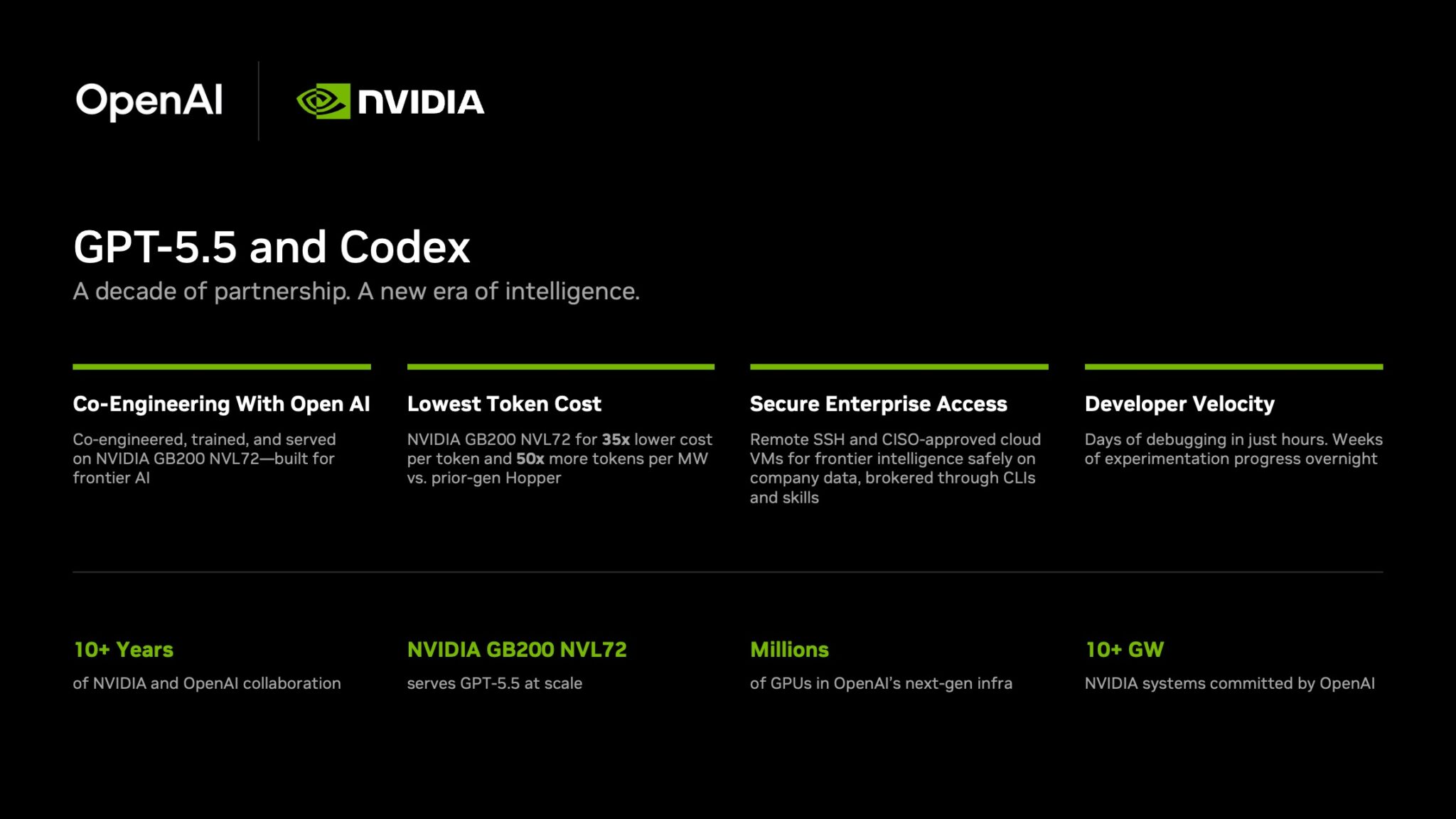
Inside the company, it says the effects are immediate. Debugging work that once took days is being finished in hours and experiments across large codebases that used to stretch over weeks are now handled overnight. Teams are also building features from natural-language prompts with fewer failed runs.
In a company-wide note urging staff to adopt the tool, CEO Jensen Huang wrote: “Let’s jump to lightspeed. Welcome to the age of AI.”
Security remains central to the rollout. Codex can connect through Secure Shell to approved cloud virtual machines, allowing agents to work with company data without moving it outside approved environments. NVIDIA said it assigned cloud VMs to employees so agents run in isolated sandboxes with full audit trails.
Also Read: Deezer Says AI Tracks Now Make Up 44% Of Uploads
The company added that the setup uses a zero-data-retention policy. Access to production systems is read-only through command-line tools and internal automation layers.
The move also highlights NVIDIA’s long relationship with OpenAI. NVIDIA said the partnership began in 2016, when Huang personally delivered the first DGX-1 AI supercomputer to OpenAI’s San Francisco office.
The two companies have since worked across hardware and model deployment. NVIDIA also said OpenAI plans to deploy more than 10 gigawatts of NVIDIA systems for future AI infrastructure.
For Gulf markets pouring money into sovereign AI and enterprise automation, the signal is clear: internal AI agents are moving from pilot phase to standard tooling.

NVIDIA Puts GPT-5.5 Codex In Hands Of 10,000 Staff

Deezer Says AI Tracks Now Make Up 44% Of Uploads

Yango Ride Introduces In-Chat Trip Planning In ChatGPT

Nano Banana 2 Arrives In MENA For Google Gemini Users