
News
Study Shows Gen Alpha’s Growing Impact On The Digital Economy
Tech-savvy children aged 8-15 are reshaping global shopping and payment trends through their heavy use of social commerce and digital tools.


A new study commissioned by Checkout.com, a global leader in digital payments, shines a spotlight on Generation Alpha (kids aged 8-15) and their increasing role in shaping the digital economy. Conducted across the UAE, UK, US, and China, the research dives into how these young consumers are influencing spending trends and reshaping commerce through technology and social media.
UAE’s Gen Alpha: Online Shopping And Gaming Enthusiasts
In the UAE, Generation Alpha is particularly adept at navigating today’s digital-first economy. The research reveals their heavy reliance on social platforms for shopping, with younger buyers gravitating toward social commerce. While 54% of millennials tend to stick to direct-to-consumer websites, 51% of Gen Z prefer shopping directly through social media.
The gaming sector is another area where the UAE’s young consumers are taking the lead. Children in the UAE spend 47% of their allowances on e-gaming, far surpassing the 28% spent by their peers in the UK, US, and China.
High-Value Purchases On The Rise
Parents’ spending on high-end items is soaring too. The report notes a 46% surge in luxury goods purchases and notable increases in home appliance and travel purchases. This trend signals a rebound in consumer confidence, particularly in recently hard-hit areas like tourism.
Interestingly, UAE kids are not just passive beneficiaries of parental spending. The study reveals that 75% of 8-year-olds and 92% of 15-year-olds in the UAE make purchases independently, often through digital platforms.
Buy Now, Pay Later Gains Traction
The research uncovers a surprising trend: a growing number of UAE children over 13 opt for “Buy Now, Pay Later” (BNPL) services. While still a small percentage (11%), this points to how younger generations are embracing alternative payment methods early on.
Global Insights: Social Commerce And Digital Influence
Globally, Generation Alpha influences about 27% of household spending, with digital purchases accounting for nearly a third of that figure. Parents increasingly buy digital products, such as educational tools and streaming services, with 47% prioritizing online learning resources.
Social media remains a dominant force in shopping habits. Across all regions, children use platforms like Instagram and TikTok to discover deals, with preferences varying slightly between countries. In the US, 57% of young shoppers rely on social media, compared to 41% in the UAE.
Physical stores, meanwhile, are becoming less popular. Just 35% of Gen Z worldwide shop in brick-and-mortar stores regularly, further underlining the shift to digital channels.
A Blueprint For Future Commerce
“Generation Alpha is playing a major role in the digital economy,” says Rory O’Neill, Chief Marketing Officer at Checkout.com. “Businesses must pay close attention to evolving customer preferences to stay competitive in this rapidly changing market”.



News
NVIDIA Puts GPT-5.5 Codex In Hands Of 10,000 Staff
The chipmaker has significantly expanded OpenAI’s latest model across teams from engineering to HR under tight internal controls.
NVIDIA has started rolling out OpenAI’s GPT-5.5 model through the Codex coding agent to more than 10,000 employees, extending the tool well beyond software teams and into core business functions.
The deployment covers engineering, product, legal, marketing, finance, sales, HR, operations and developer programs. Staff are using Codex for coding, internal research and routine knowledge work as companies test whether AI agents can move from demos to daily use.
GPT-5.5 is running on NVIDIA’s GB200 NVL72 rack-scale systems, linking OpenAI’s newest model directly to the chipmaker’s latest infrastructure push. NVIDIA said the systems cut cost per million tokens by 35 times and raise token output per second per megawatt by 50 times versus earlier generations.
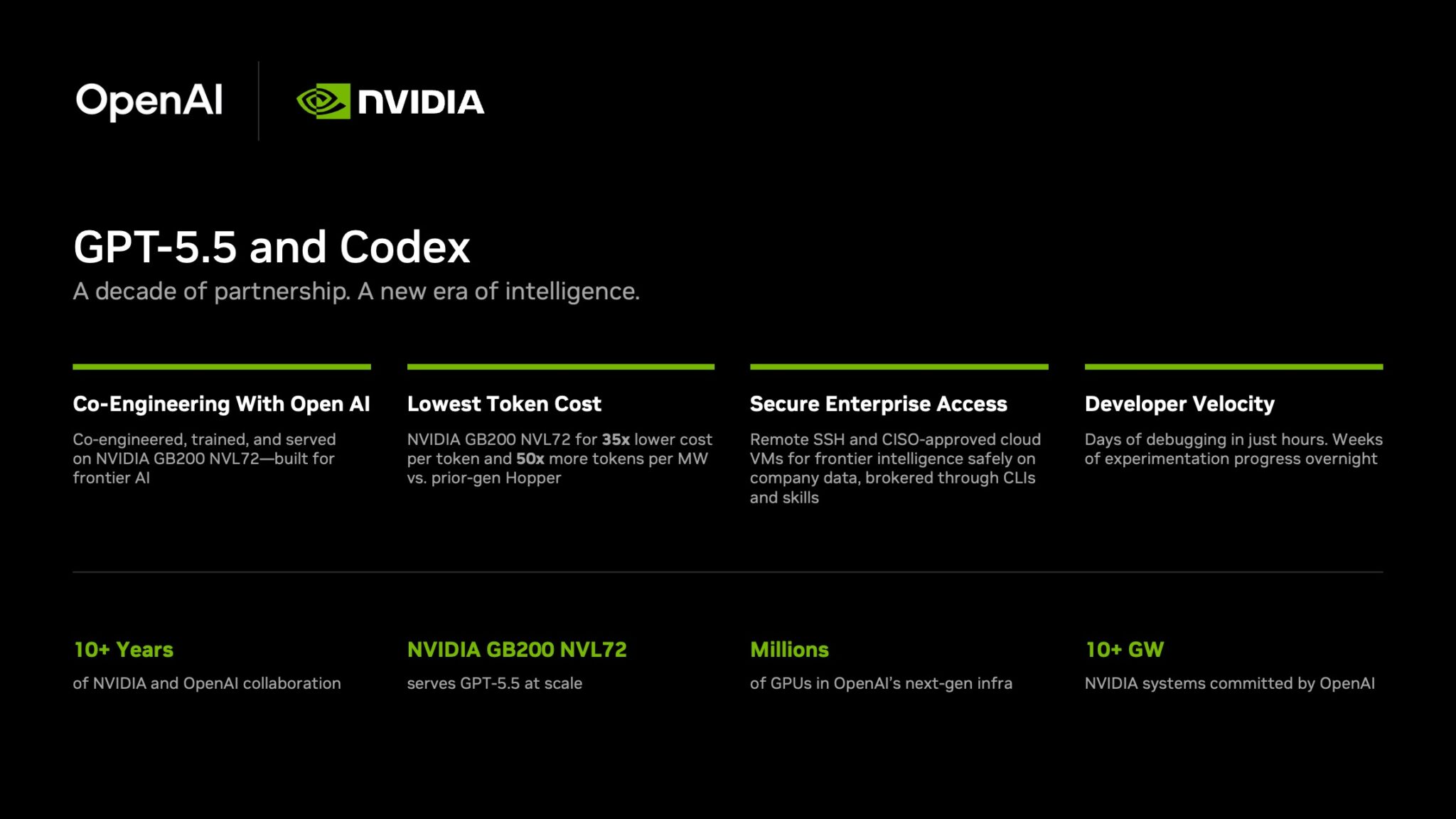
Inside the company, it says the effects are immediate. Debugging work that once took days is being finished in hours and experiments across large codebases that used to stretch over weeks are now handled overnight. Teams are also building features from natural-language prompts with fewer failed runs.
In a company-wide note urging staff to adopt the tool, CEO Jensen Huang wrote: “Let’s jump to lightspeed. Welcome to the age of AI.”
Security remains central to the rollout. Codex can connect through Secure Shell to approved cloud virtual machines, allowing agents to work with company data without moving it outside approved environments. NVIDIA said it assigned cloud VMs to employees so agents run in isolated sandboxes with full audit trails.
Also Read: Deezer Says AI Tracks Now Make Up 44% Of Uploads
The company added that the setup uses a zero-data-retention policy. Access to production systems is read-only through command-line tools and internal automation layers.
The move also highlights NVIDIA’s long relationship with OpenAI. NVIDIA said the partnership began in 2016, when Huang personally delivered the first DGX-1 AI supercomputer to OpenAI’s San Francisco office.
The two companies have since worked across hardware and model deployment. NVIDIA also said OpenAI plans to deploy more than 10 gigawatts of NVIDIA systems for future AI infrastructure.
For Gulf markets pouring money into sovereign AI and enterprise automation, the signal is clear: internal AI agents are moving from pilot phase to standard tooling.

NVIDIA Puts GPT-5.5 Codex In Hands Of 10,000 Staff

Deezer Says AI Tracks Now Make Up 44% Of Uploads

Yango Ride Introduces In-Chat Trip Planning In ChatGPT

Nano Banana 2 Arrives In MENA For Google Gemini Users


