News
UAE-Based Drone Company Plans Wider MENA Expansion
UVL Robotics is broadening the scope of its commercial drone activities across the Middle East.

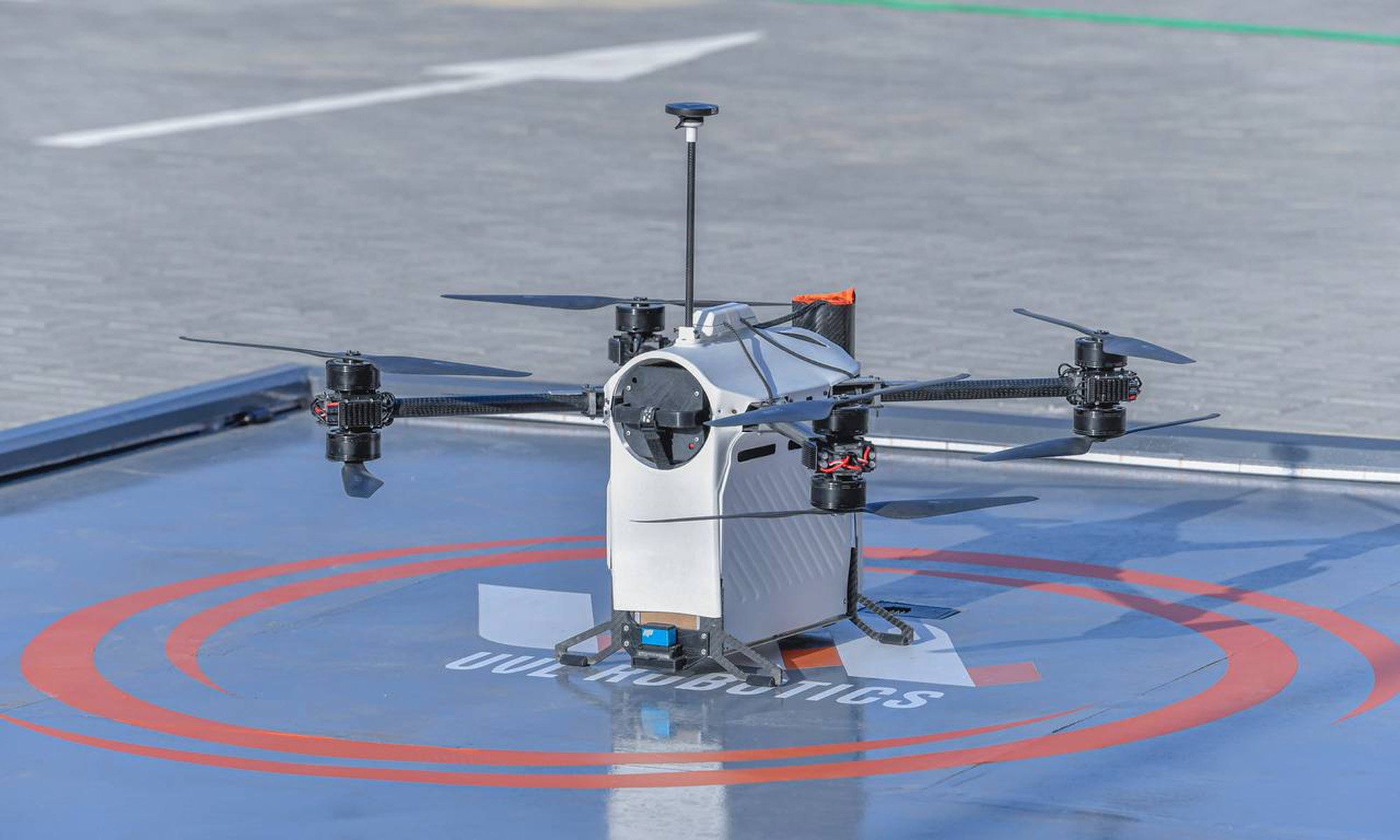
UVL Robotics, a UAE-based robotics startup, is the first company to provide a fully operational commercial drone delivery service in the MENA region. After winning several high-profile contracts, the company is now preparing to trial drone flights in Abu Dhabi — an Emirate with over 200 islands.
“It all depends on the graders,” explains CEO Eugene Grankin. “If they rate us well, we could soon get the permission to fly in Abu Dhabi.” Grankin has good reason to be confident. In 2021, after a tropical cyclone hit Oman, UVL drones were successfully deployed to deliver supplies. “We could deliver medicine to remote areas where it took a long time to reach by car,” the CEO explained.
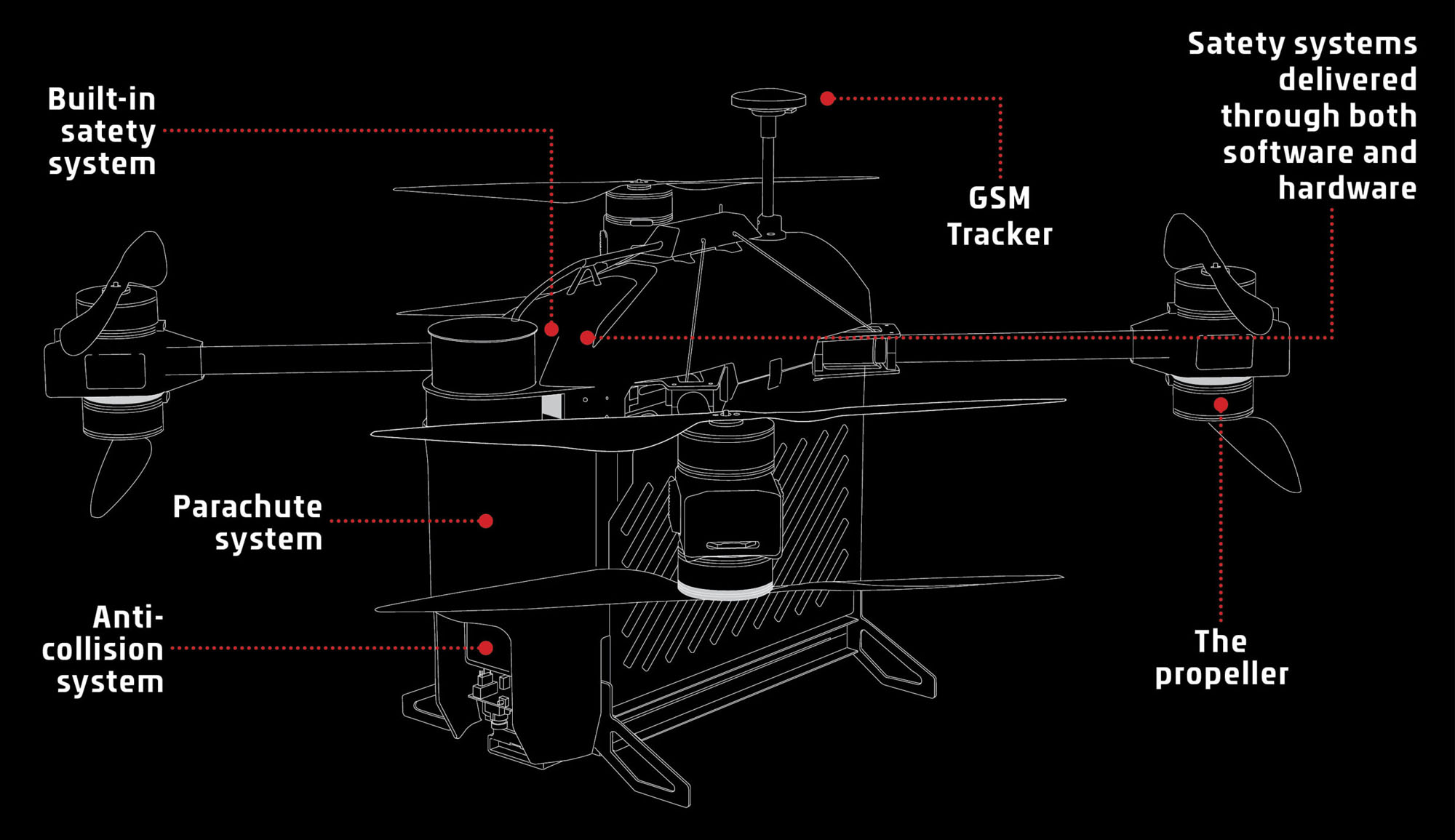
Today, UVL Robotics is focused on inventory management as well as delivery. In Europe, UVL drones can scan 300-750 pallets in under five seconds. The company now uses drones to perform stocktaking at more than 50 warehouse locations, with global companies like PepsiCo utilizing the service.
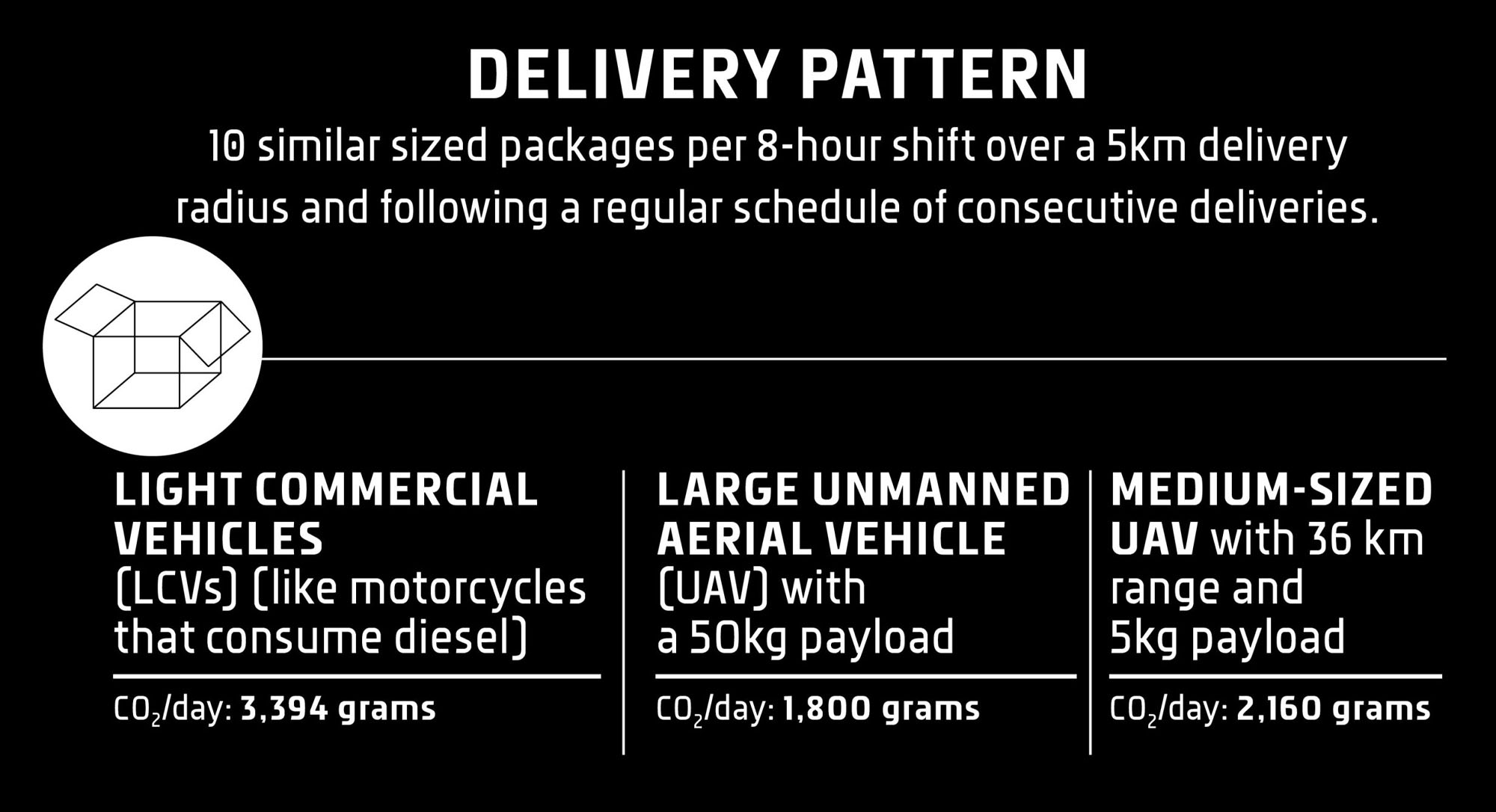
In the Middle East, sustainability and CO₂ reduction are the primary drivers of drone adoption. Saudi Arabia plans to cut carbon emissions by 278 million tonnes per year, while the UAE has plans to reduce its own output by 31%. Research conducted by UVL found that drones produce 36% fewer emissions than moving the equivalent load volume by truck, despite each UAV having a payload of just 10kg.
As well as reducing CO₂, drones can also improve operational efficiency. In Oman, coastlines and rugged terrain mean that food deliveries typically take 30-60 minutes by human courier. With drones, that time is cut to a predictable 15 minutes. In addition, drones can handle over 30 orders daily, compared to just 20 when delivered by regular vehicle.
Also Read: USB-C Will Be Mandatory From 2025 For All Saudi Smart Devices
Meanwhile, at King Abdullah University of Science and Technology (KAUST) in Saudi Arabia, UVL Robotics is preparing to launch campus-wide smart loading stations, which the company hopes will act as a blueprint for future smart city projects across the region.



News
NVIDIA Puts GPT-5.5 Codex In Hands Of 10,000 Staff
The chipmaker has significantly expanded OpenAI’s latest model across teams from engineering to HR under tight internal controls.
NVIDIA has started rolling out OpenAI’s GPT-5.5 model through the Codex coding agent to more than 10,000 employees, extending the tool well beyond software teams and into core business functions.
The deployment covers engineering, product, legal, marketing, finance, sales, HR, operations and developer programs. Staff are using Codex for coding, internal research and routine knowledge work as companies test whether AI agents can move from demos to daily use.
GPT-5.5 is running on NVIDIA’s GB200 NVL72 rack-scale systems, linking OpenAI’s newest model directly to the chipmaker’s latest infrastructure push. NVIDIA said the systems cut cost per million tokens by 35 times and raise token output per second per megawatt by 50 times versus earlier generations.
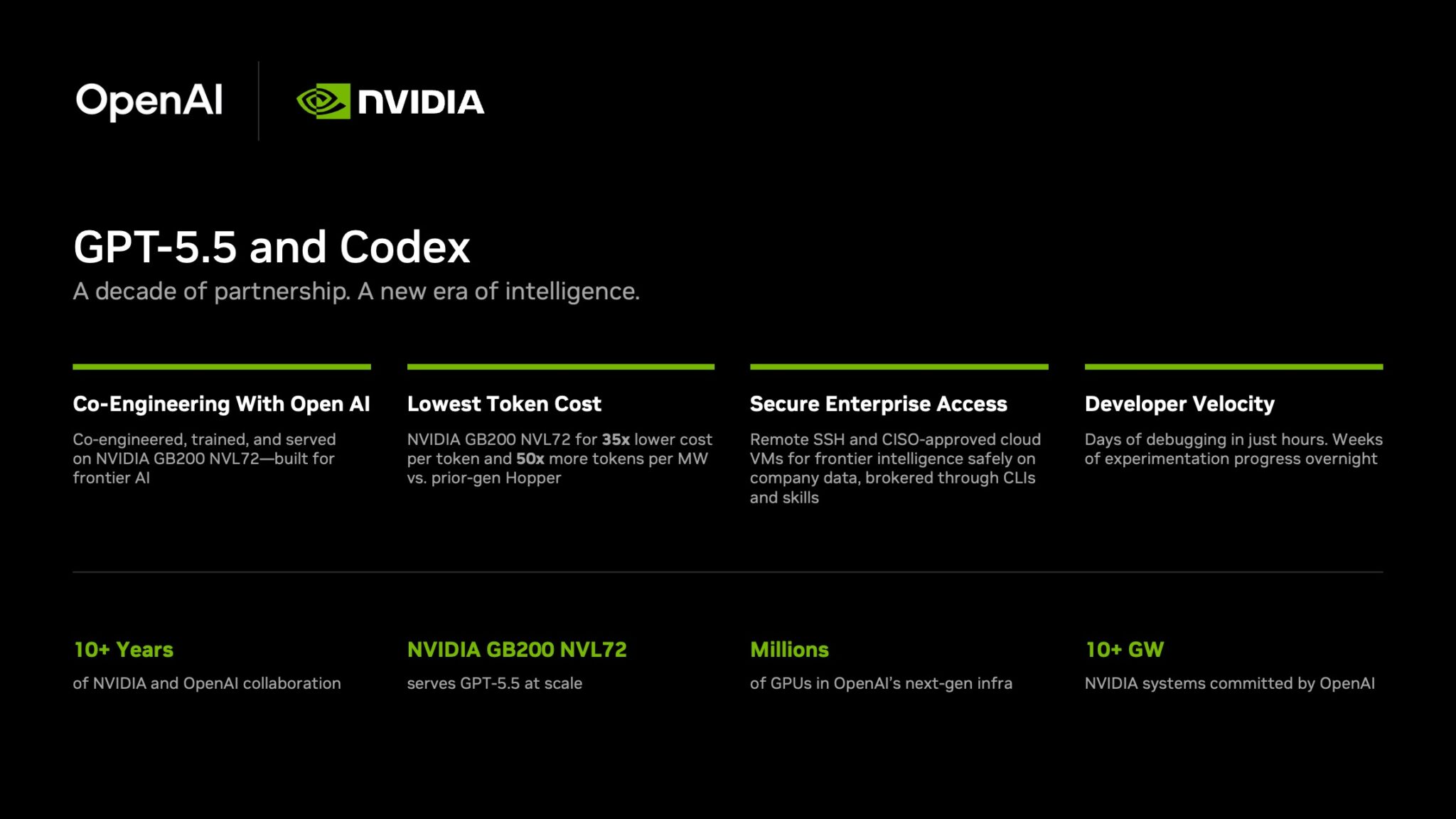
Inside the company, it says the effects are immediate. Debugging work that once took days is being finished in hours and experiments across large codebases that used to stretch over weeks are now handled overnight. Teams are also building features from natural-language prompts with fewer failed runs.
In a company-wide note urging staff to adopt the tool, CEO Jensen Huang wrote: “Let’s jump to lightspeed. Welcome to the age of AI.”
Security remains central to the rollout. Codex can connect through Secure Shell to approved cloud virtual machines, allowing agents to work with company data without moving it outside approved environments. NVIDIA said it assigned cloud VMs to employees so agents run in isolated sandboxes with full audit trails.
Also Read: Deezer Says AI Tracks Now Make Up 44% Of Uploads
The company added that the setup uses a zero-data-retention policy. Access to production systems is read-only through command-line tools and internal automation layers.
The move also highlights NVIDIA’s long relationship with OpenAI. NVIDIA said the partnership began in 2016, when Huang personally delivered the first DGX-1 AI supercomputer to OpenAI’s San Francisco office.
The two companies have since worked across hardware and model deployment. NVIDIA also said OpenAI plans to deploy more than 10 gigawatts of NVIDIA systems for future AI infrastructure.
For Gulf markets pouring money into sovereign AI and enterprise automation, the signal is clear: internal AI agents are moving from pilot phase to standard tooling.

NVIDIA Puts GPT-5.5 Codex In Hands Of 10,000 Staff

Deezer Says AI Tracks Now Make Up 44% Of Uploads

Yango Ride Introduces In-Chat Trip Planning In ChatGPT

Nano Banana 2 Arrives In MENA For Google Gemini Users