
News
5D Storage Technology Can Fit 500TB On A Small Disc
This method could theoretically be used to archive data for as long as 13.8 billion years.


While most consumers today are perfectly satisfied with the capacity and reliability of modern solid-state drives (SSDs), various organizations that are required to archive massive quantities of data are deeply aware of the limitations of not just SSDs but other currently available storage technologies as well.
Soon, they might be able to store up to 500TB of data on a CD-sized disc thanks to a new energy-efficient laser-writing method for producing high-density nanostructures in silica glass. Called five-dimensional (5D) optical data storage, this method could theoretically be used to archive data for as long as 13.8 billion years, and the optical discs produced by it can survive temperatures as high as 1,000 degrees Celsius.
“With the current system, we have the ability to preserve terabytes of data, which could be used, for example, to preserve information from a person’s DNA,” said Peter G. Kazansky, leader of the research team behind the new data storage technology.
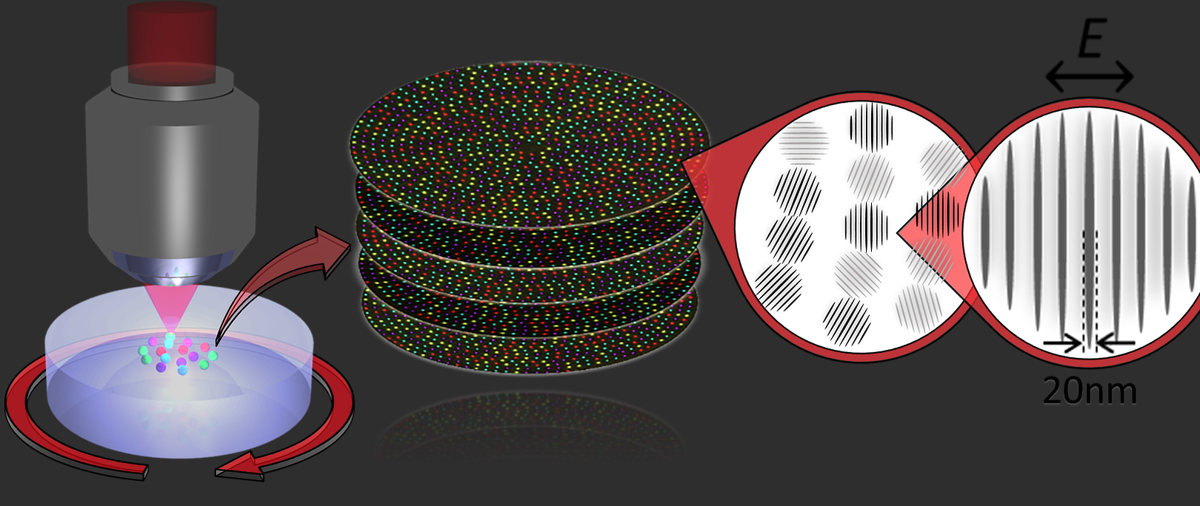
5D optical data storage isn’t actually an entirely new invention, but its practical applications were greatly limited in the past because of its slow write speed. To improve it, the research team from the University of Southampton in the UK used a femtosecond laser to produce an optical phenomenon known as near-field enhancement, minimizing the thermal damage that prevented earlier researchers from making 5D optical data storage truly usable.
Also Read: Japan Sets A New Internet Speed Record With 319 Terabits Per Second
“This new approach improves the data writing speed to a practical level, so we can write tens of gigabytes of data in a reasonable time,” said doctoral researcher Yuhao Lei. By a reasonable time, Lei means about 100 pages of text (roughly 230 kilobytes of data) per second.
When you compare that figure to the writing speeds of modern SSDs (anywhere from 200 megabytes per second to 4,000 megabytes per second), it becomes apparent that regular consumers won’t be replacing their storage drives with it anytime soon.

News
Deezer Says AI Tracks Now Make Up 44% Of Uploads
The streamer says nearly 75,000 AI-made songs now hit its platform each day, even as those tracks account for just 1% to 3% of plays.


AI-generated music is becoming a real headache for music platforms, according to Deezer. The streaming service says it now receives nearly 75,000 AI-made tracks a day, equal to about 44% of all daily uploads to the platform.
The figure is up sharply from 10,000 daily AI uploads when Deezer launched its detection tool back in January 2025. The jump shows how quickly products such as Suno and Udio have made song creation cheap, fast, and easy to scale.
Despite the volume, Deezer says AI tracks still only account for 1% to 3% of total streams. The music gets few human listeners, but upload pressure is rising. The company says it is also seeing more “fraudulent” submissions.
Its response so far has been practical. Deezer has removed AI-generated songs from recommendation systems, demonetized them, and stopped storing high-resolution versions of those files.
The company also says it’s the only streaming platform currently tagging AI-generated tracks at scale, using that claim to position its moderation tools as a wider industry model.
“AI-generated music is now far from a marginal phenomenon and as daily deliveries keep increasing, we hope the whole music ecosystem will join us in taking action to help safeguard artist’s rights and promote transparency for fans,” CEO Alexis Lanternier said in a blog post.
Deezer has started licensing the detection technology to other companies, turning an internal control system into a commercial product. It says the tool can already identify music created with Suno and Udio, and can be extended to other generators if training data is available.
Also Read: Nano Banana 2 Arrives In MENA For Google Gemini Users
The company is also working on detection methods that would not require training datasets, a harder technical step that could widen coverage as new music models appear.
Rivals are taking mixed approaches. Spotify has rolled out policies aimed at curbing AI music. Apple Music is asking artists and labels to disclose AI-made tracks. Qobuz has begun automated labeling, while Bandcamp has banned AI music outright.
For now, Deezer’s numbers suggest the real issue is not listener demand. It’s supply.

Deezer Says AI Tracks Now Make Up 44% Of Uploads

Yango Ride Introduces In-Chat Trip Planning In ChatGPT

Nano Banana 2 Arrives In MENA For Google Gemini Users

GluCare Rebrands To Metabolic, Dropping Diabetes-Only Identity


