News
884 Scam Pages Unearthed In $280K Global Investment Scam
Links to the pages were shown in Facebook ads purchased by fraudsters, who lured users into making fake investments in market-leading companies.


Group-IB, a global cybersecurity firm working alongside the UAE Cybersecurity Council, has published new research outlining an international fake investment scam that significantly impacted social media users in the Middle East.
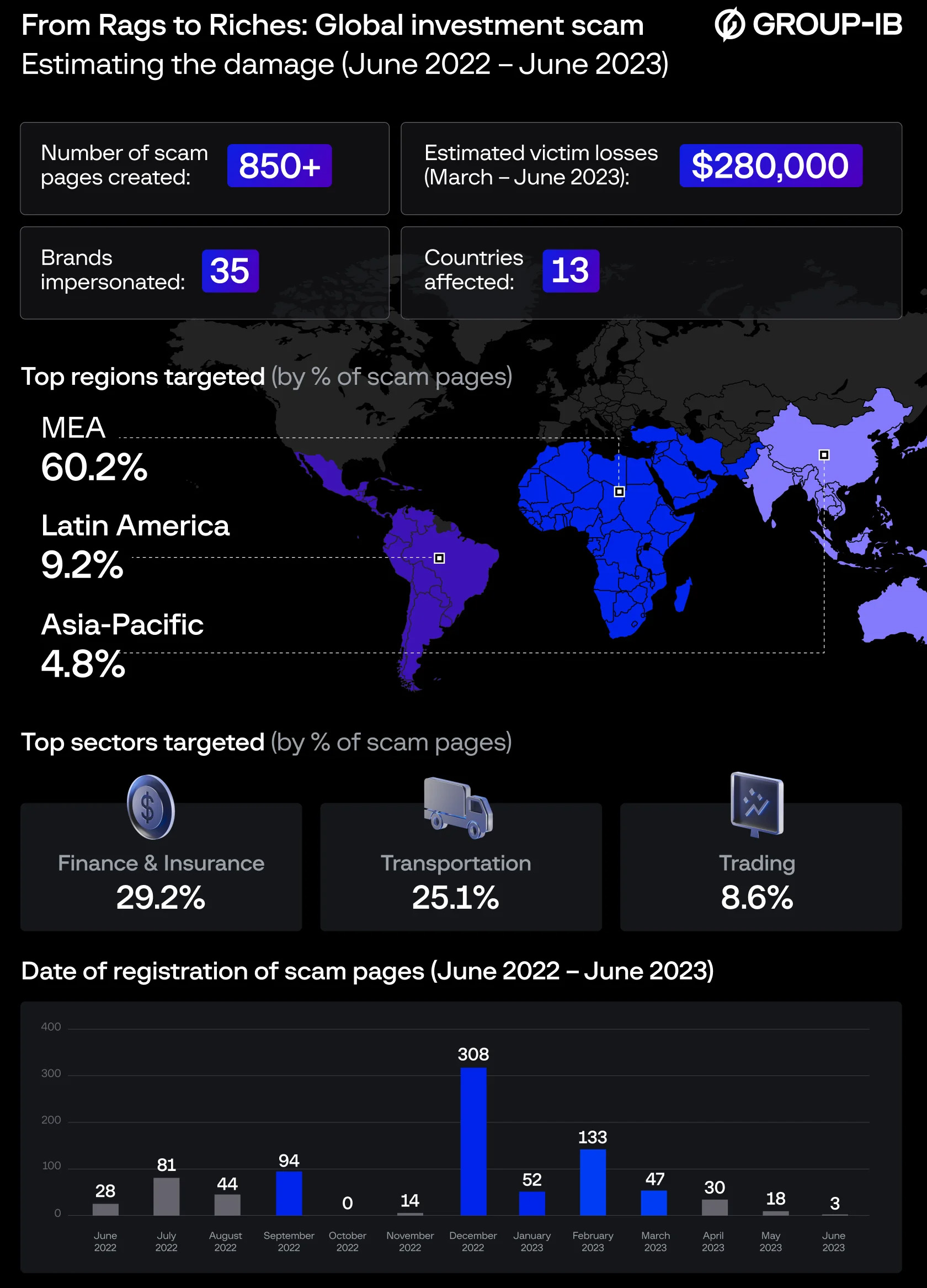
Experts from Group-IB’s Digital Risk Protection team discovered 884 scam pages with traffic coming from Facebook advertisements purchased by the fraudsters. The social media campaign offered users the opportunity to invest in one of 35 market-leading firms, including legitimate financial, insurance, transportation, oil, gas, and construction companies.
Group-IB researchers found English, Arabic, and Spanish Facebook ads. In Arabic-language advertisements, scammers enticed individuals with bold claims that they could “earn millions” by investing “a mere $200” amount.
If a user clicked on an ad, they were redirected to a scam page containing legitimate branding from a prominent company, along with a request for their name, email address, and phone number.
After filling out the form, users would receive daily emails claiming to be from a trading portal. Users would be urged to deposit funds into the fake trading account to begin buying stocks. The scammers would even resort to phone calls if a user didn’t respond. The elaborate con also requested bank details, ID, and passport copies.
Also Read: The Largest Data Breaches In The Middle East
“Retail investing is becoming increasingly popular among individuals who are looking for ways to diversify their income. This particular scam is notable as the cybercriminals leverage multiple communication channels, such as email and direct phone calls, as part of their social engineering efforts. We urge individuals to never share personal information or money with third parties unless you are certain of their legitimacy,” said Sharef Hlal, Head of Group-IB’s MEA Digital Risk Protection Analytics Team.
In total, 60% of the scam pages targeted users from the Middle East and Africa (MEA) region. Based on Group-IB’s research, the criminal campaign is thought to have caused $280,000 in financial damages between March and June 2023.



News
Lebanon Ministers Meet Visa Over National Digital Payment Platform
Finance and technology ministers say a comparative study and roadmap will follow before any decision on adopting a model.


Lebanon’s finance and technology ministers met representatives from Visa last week to discuss a proposed unified national digital payment platform for government services, according to a readout from the Ministry of Finance.
The meeting brought together Finance Minister Yassin Jaber, Minister of State for Technology and Artificial Intelligence Kamal Shehadeh, a Visa delegation, and experts from both ministries. Discussion focused on whether Lebanon could establish a single platform through which citizens and institutions would pay taxes, fees, fines and other official transactions electronically, using mobile phones and other digital channels.
The Visa delegation presented examples from countries that have adopted unified government payment platforms, including the United Arab Emirates, Singapore, Estonia and Jordan. According to the readout, the examples were presented as having increased collection rates and expanded financial inclusion.
Talks covered settlement mechanisms, direct transfer to the treasury account, financial reconciliation, risk management, cybersecurity, fees, and an operational model that would involve the private sector. The parties agreed to continue technical and institutional consultations, prepare a comparative study, and develop an implementation roadmap before any decision on adopting a model for Lebanon.
Jaber said the Ministry of Finance had already enabled citizens to pay using credit cards and e-wallets through transfer companies, but described the proposed platform as a further step. He framed the development of electronic payment and collection systems as a priority within the ministry’s modernization plan.
Also Read: Deezer Says AI Tracks Now Make Up 44% Of Uploads
Shehadeh outlined the citizen-facing concept as a single mobile application through which users could settle obligations to ministries, government institutions and other bodies.
“The idea, in short, is that any citizen downloads an application on their mobile phone, through which they can pay all service obligations for all ministries, government institutions, or those owned by the Lebanese state, and others as well, as the platform is not limited only to state institutions,” he said.
Shehadeh added that the platform would not displace banks and money transfer companies that currently provide collection services to the state, calling it complementary to their work.

Lebanon Ministers Meet Visa Over National Digital Payment Platform

AltoVolo Releases Sigma Footage & Sets Date For Demonstrator

Careem Launches Lebanon Aid Drive With WFP

United Arab Emirates To Quit OPEC After 59 Years

YouTube Tests Conversational AI Search Tool

Yango Ride Introduces In-Chat Trip Planning In ChatGPT

Deezer Says AI Tracks Now Make Up 44% Of Uploads

NVIDIA Puts GPT-5.5 Codex In Hands Of 10,000 Staff
United Arab Emirates To Quit OPEC After 59 Years