News
AKcess Brings Its Blockchain-Based Digital ID Solution To Kuwait
Designed to make both paper and online forms obsolete, AKcess uses nothing but a smartphone app to collect and validate KYC data.


Companies in the financial sector, as well as governments and enterprises, spend a lot of time, effort, and money verifying the identities of their customers. That’s because the so-called Know Your Customer (KYC) process often relies on outdated technology and inefficient manual processes. AKcess would like to revolutionize the KYC process using its secure digital ID solution for private and commercial use.
The solution takes advantage of blockchain technology (the same technology that powers and secures cryptocurrencies such as Bitcoin), using it to immutably store collected user data.
Designed to make both paper and online forms obsolete, AKcess uses nothing but a smartphone app to collect and validate KYC data. The submitted information can then be verified in a number of different ways, such as by taking a selfie or using a third-party verifier. When a user approaches an institution that collects KYC information, he or she can simply share it via AKcess, making onboarding effortless.
“KYC is a major challenge for all financially regulated and unregulated companies, but the bigger challenge is to update the KYC after initial onboarding of a client,” said Nehme AbouZeid, Founding member and Chief Technology Officer of Akcess, in an interview with Entrepreneur Magazine. “Using a combination of our mobile app and our blockchain network, we were able to find a solution acceptable to all parties, the regulator and the institutions.”
Also Read: New Digital ID Verification Solution Available To Turkish Fintech Apps
The blockchain-based digital ID solution could be a boon to banks, small and medium enterprises (SMEs), government organizations, educational institutions, healthcare providers, insurance companies, and more. In other words, its impact could be significant.
AKcess has recently opened offices in Kuwait, and the company also has projects underway in several other countries in the Middle East including Egypt, UAE, and Qatar.



News
NVIDIA Puts GPT-5.5 Codex In Hands Of 10,000 Staff
The chipmaker has significantly expanded OpenAI’s latest model across teams from engineering to HR under tight internal controls.

NVIDIA has started rolling out OpenAI’s GPT-5.5 model through the Codex coding agent to more than 10,000 employees, extending the tool well beyond software teams and into core business functions.
The deployment covers engineering, product, legal, marketing, finance, sales, HR, operations and developer programs. Staff are using Codex for coding, internal research and routine knowledge work as companies test whether AI agents can move from demos to daily use.
GPT-5.5 is running on NVIDIA’s GB200 NVL72 rack-scale systems, linking OpenAI’s newest model directly to the chipmaker’s latest infrastructure push. NVIDIA said the systems cut cost per million tokens by 35 times and raise token output per second per megawatt by 50 times versus earlier generations.
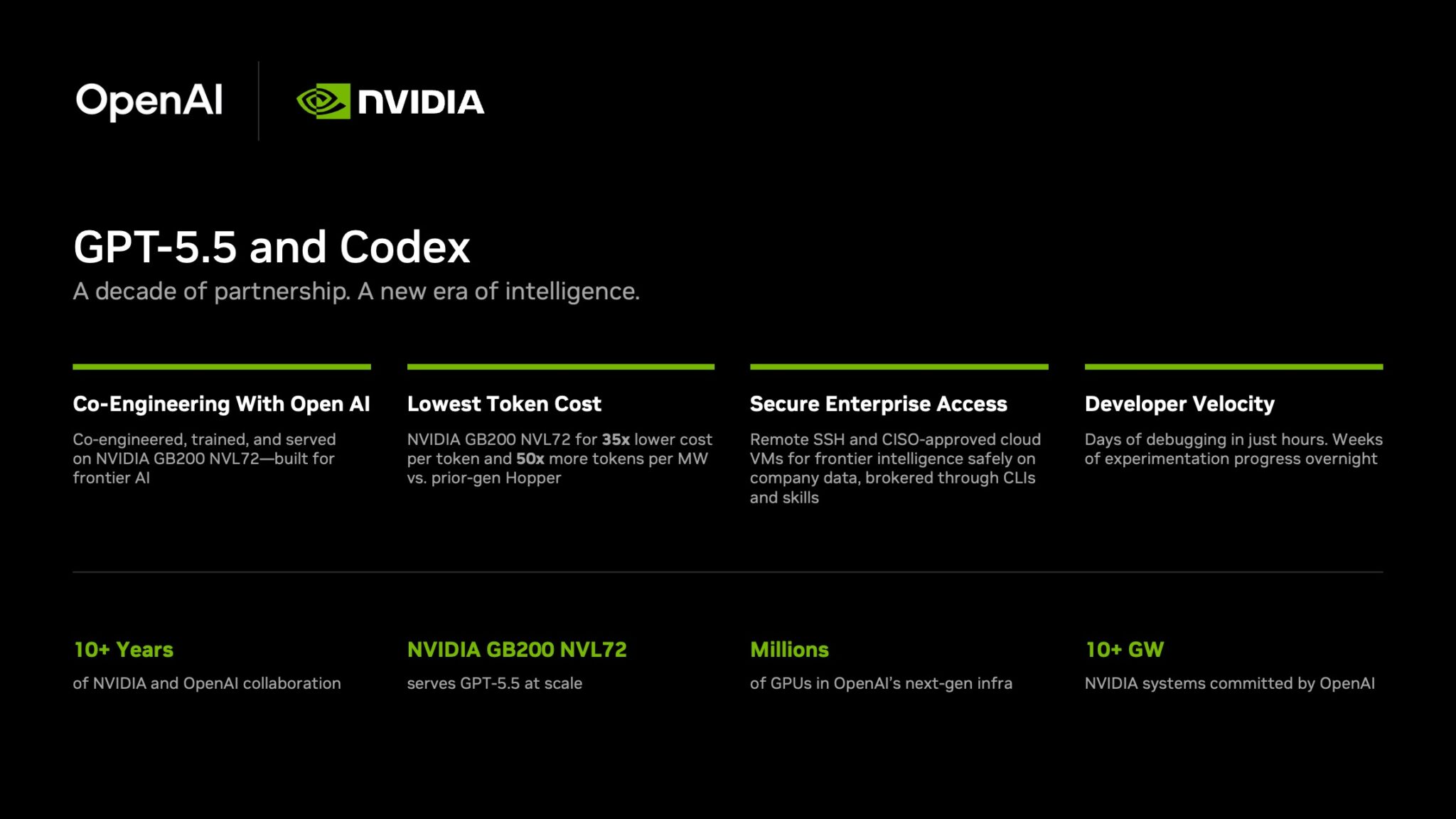
Inside the company, it says the effects are immediate. Debugging work that once took days is being finished in hours and experiments across large codebases that used to stretch over weeks are now handled overnight. Teams are also building features from natural-language prompts with fewer failed runs.
In a company-wide note urging staff to adopt the tool, CEO Jensen Huang wrote: “Let’s jump to lightspeed. Welcome to the age of AI.”
Security remains central to the rollout. Codex can connect through Secure Shell to approved cloud virtual machines, allowing agents to work with company data without moving it outside approved environments. NVIDIA said it assigned cloud VMs to employees so agents run in isolated sandboxes with full audit trails.
Also Read: Deezer Says AI Tracks Now Make Up 44% Of Uploads
The company added that the setup uses a zero-data-retention policy. Access to production systems is read-only through command-line tools and internal automation layers.
The move also highlights NVIDIA’s long relationship with OpenAI. NVIDIA said the partnership began in 2016, when Huang personally delivered the first DGX-1 AI supercomputer to OpenAI’s San Francisco office.
The two companies have since worked across hardware and model deployment. NVIDIA also said OpenAI plans to deploy more than 10 gigawatts of NVIDIA systems for future AI infrastructure.
For Gulf markets pouring money into sovereign AI and enterprise automation, the signal is clear: internal AI agents are moving from pilot phase to standard tooling.

NVIDIA Puts GPT-5.5 Codex In Hands Of 10,000 Staff

Deezer Says AI Tracks Now Make Up 44% Of Uploads

Yango Ride Introduces In-Chat Trip Planning In ChatGPT

Nano Banana 2 Arrives In MENA For Google Gemini Users