
News
Cybersecurity Firm Uncovers 2,400+ Fake Arabic Job Pages
The scam targeted internet users across 13 Middle East and North African countries.


Global cybersecurity leader Group-IB has revealed new research from its center in Dubai detailing a widespread fake job scam campaign targeting Arabic speakers in the MENA region.
Digital Risk Protection experts used AI and text analyzing tools to uncover over 2,400 fake job pages impersonating companies from 13 countries. The posts were created on social media platforms throughout the entirety of 2022.
On the job pages, fraudsters spoofed more than 40 of the MENA region’s largest companies. They published vacancies in Arabic offering salaries too good to be true, including “4,500 euros (USD $4,800) for drivers and painters”. Once interested victims interacted with links on the pages, they were taken to fake phishing sites where they were asked to enter login credentials and passwords.
Which Countries Were Targeted?
Arabic-speaking individuals were the exclusive targets of this particular scamming campaign, with Egyptian companies most frequently spoofed by the criminals.
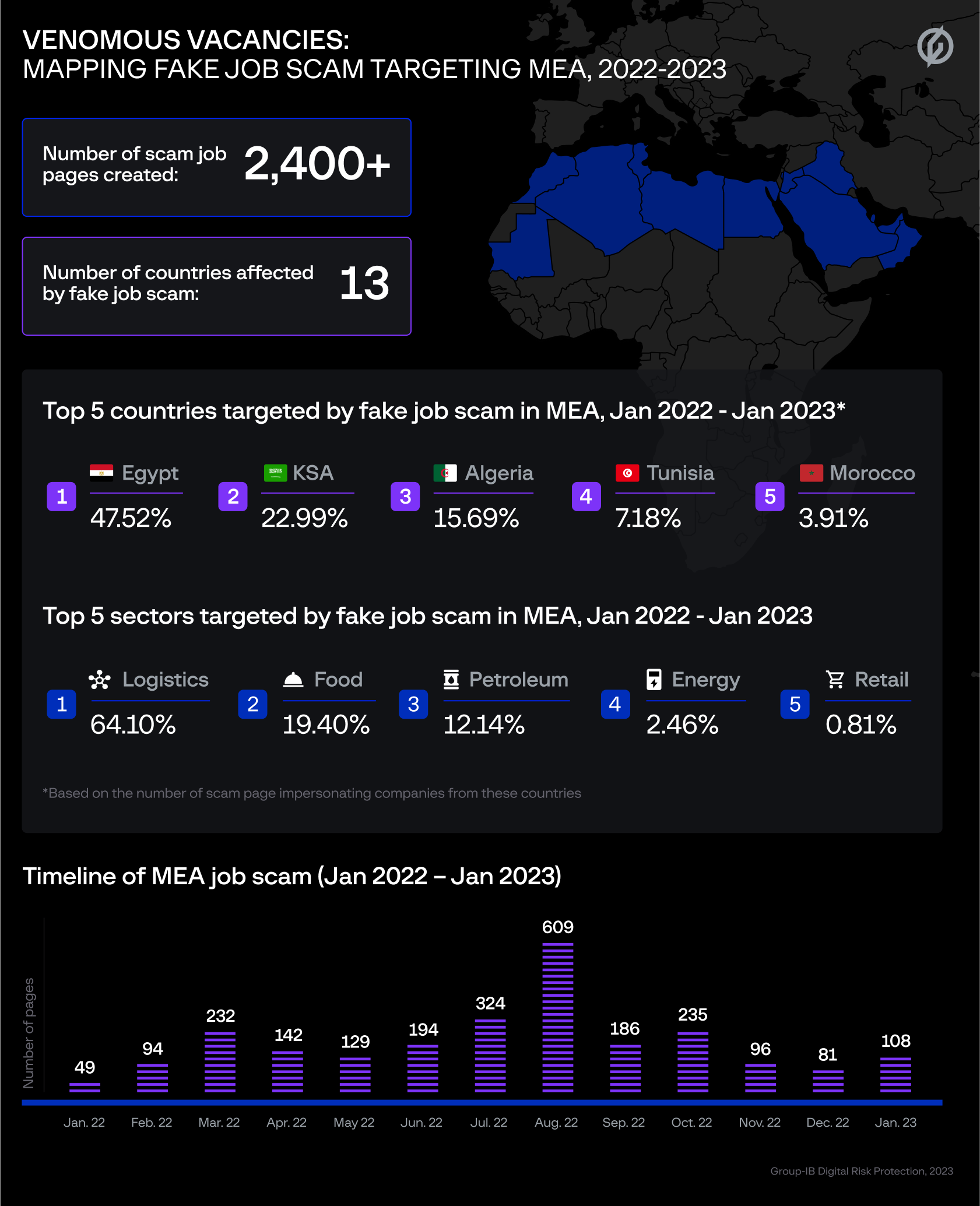
According to Group-IB, “48% of all the fake profiles created on Facebook spoofed companies from Egypt. Organizations from Saudi Arabia (23% of all scam pages), Algeria (16%), Tunisia (7%), and Morocco (4%) were also frequently mimicked as well as offering individuals jobs at the 2022 FIFA World Cup in Qatar”.
What Industries Were Selected?
The scammers responsible for the fake job pages made adverts across multiple industries, though logistics firms were a popular target (64%). Group-IB noted that “scammers targeting MENA users are particularly fond of impersonating logistics enterprises due to the high potential ROI. The food and beverage (20% of scam pages) and petroleum (12%) industries were also heavily impersonated by the scammers, with one particular company being impersonated on more than 1,000 fake pages”.
Also Read: Is Your Phone Hacked? How To Find Out & Protect Yourself
Staying Safe Online
Group-IB warned internet users to stay vigilant and always confirm URLs when following links that supposedly lead to a company’s website — a particularly important habit on social media sites. Users should enable two-factor authentication (2FA) for all online accounts supporting the security feature and ensure they never use the same password across multiple accounts.



News
Nano Banana 2 Arrives In MENA For Google Gemini Users
Google brings its latest image model to Gemini and Search, adding 4K output and tighter text control for regional users.

Google has opened access to Nano Banana 2 across the Middle East and North Africa, pushing its newest image model into everyday tools rather than keeping it inside the exclusive (and expensive) Pro tier.
The rollout spans the Google Gemini desktop and mobile apps, and extends to Google Search through Lens and AI Mode. Developers can also test it in preview via AI Studio and the Gemini API.
Nano Banana 2 runs on Gemini Flash, Google’s fast inference layer. The focus is speed, but also control. Users can export visuals from 512px up to 4K, adjusting aspect ratios for everything from vertical social posts to widescreen displays.
The model maintains character likeness across up to five figures and preserves fidelity for as many as 14 objects within a single workflow. This enables visual continuity across scenes, iterations, or edits — supporting projects like short films, storyboards, and multi-scene narratives. Text rendering has also been improved, delivering legible typography in mockups and greeting cards, with built-in translation and localization directly within images.
Also Read: RØDE Adds Direct iPhone Pairing To Wireless GO And Pro Mics
Under the hood, the system taps Gemini’s broader knowledge base and pulls in real-time information and imagery from web search to render specific subjects more accurately. Lighting and fine detail have been upgraded, without slowing output.
By embedding the model inside Gemini and Search, Google is normalizing advanced image generation for a mass audience. In MENA, where startups and marketing teams are leaning heavily on AI to scale content across languages and borders, that shift lands at a practical moment.
The move also folds creative tooling deeper into search itself, so that image generation is no longer a separate workflow. It now sits right next to the query box.

Nano Banana 2 Arrives In MENA For Google Gemini Users

GluCare Rebrands To Metabolic, Dropping Diabetes-Only Identity

Apple’s March 4 Event Rumored To Put New Macs In Play

Google Adds Arabic AI Music Creation For Ramadan


