
News
Dubai Hospital Delivery Drone Completes Successful First Trial
The unmanned aerial vehicle allows the hospital to rapidly deliver medications to patients, saving lives in emergencies.

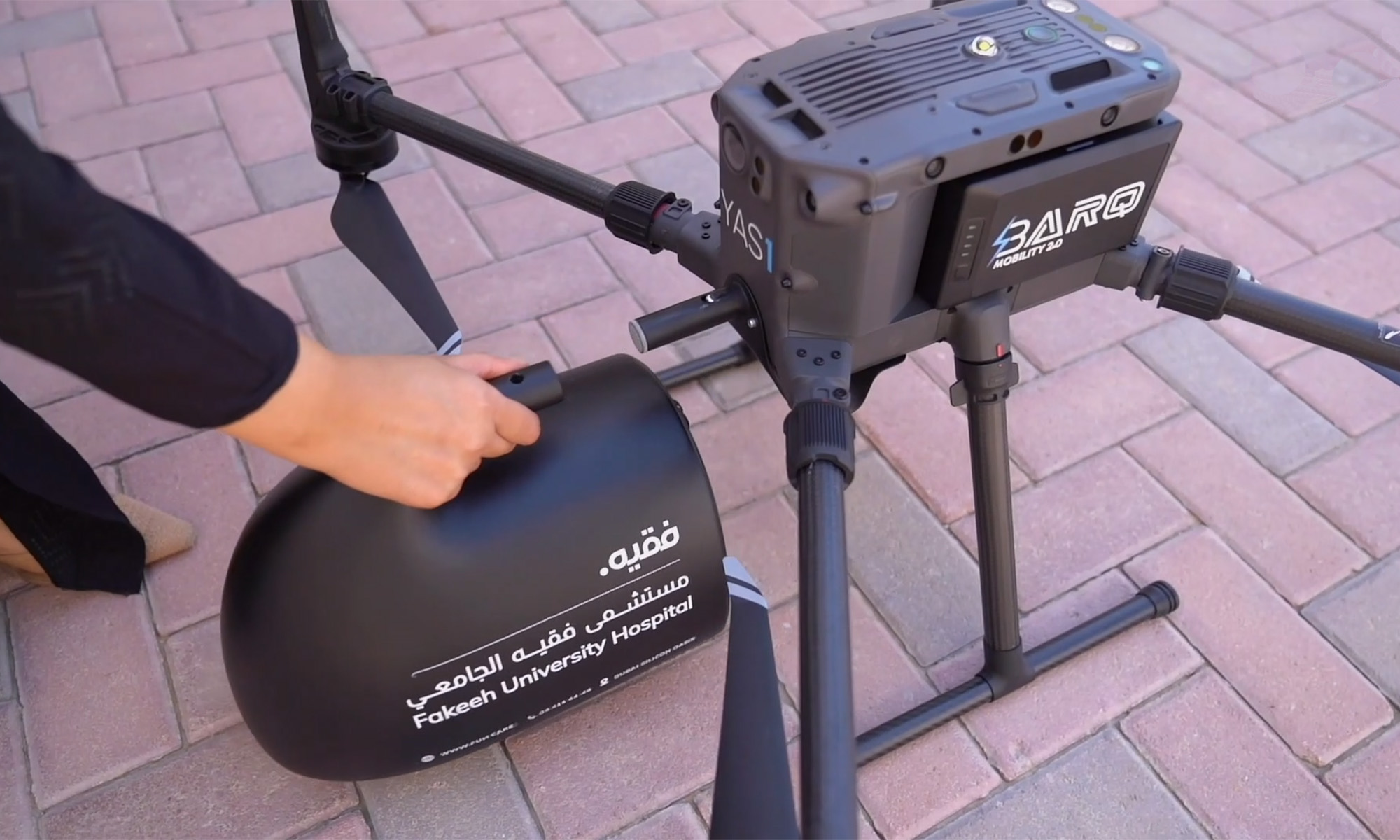
Fakheeh University Hospital in Dubai has made history by flying a delivery of medicine to a patient’s house in Cedre Villas (Dubai Silicon Oasis) using a small, unmanned drone.
The groundbreaking achievement followed a series of trials in collaboration with the Dubai Future Foundation (DFF) and the Dubai Civil Aviation Authority (DCAA).
The introduction of drone deliveries represents a significant shift in healthcare accessibility. The small aerial craft could also prove life-saving in emergency situations, as they can quickly zip to their destination without having to worry about traffic jams or search for helicopter-sized landing spaces.
Fakeeh University Hospital CEO, Dr Fatih Mehmet Gul, was rightfully proud of the technological achievement: “Since our establishment, we have consistently embraced technological advancements to provide innovative services. However, this initiative marks a substantial leap forward in enhancing healthcare accessibility and achieving complete digitalization”.
Drone use also significantly reduces the hospital’s carbon footprint compared to traditional delivery methods — a factor that is especially important to the Dubai Integrated Economic Zones Authority and the 2040 Urban Master Plan.
Also Read: Saudi Aviation Sector Embraces Tech To Meet Vision 2030 Goals
Director-general of Dubai Silicon Oasis, Dr Juma Al Matrooshi, said, “In line with our role within the Dubai Programme to Enable Drone Transportation, we are committed to empowering entities from the UAE and abroad to develop and test new drone solutions that boost efficiency and convenience”.
In 2021, the Crown Prince of Dubai, Sheikh Hamdan bin Mohammed, announced a program that would enable the use of drones in multiple sectors, including shipping, food logistics, health, and security, with the aim of boosting global competitiveness and innovation within the Emirate.




News
Meta’s New AI Tool Builds Images From Public Instagram Photos
Muse Image lets anyone generate AI visuals from your public posts, unless you find the opt-out that’s buried in your account settings.

Meta has a new AI image generator, and it comes with a feature that has privacy advocates alarmed. Muse Image, launched Tuesday by the company’s Superintelligence Labs division, lets users generate AI images by @ mentioning any public Instagram account — pulling that person’s photos into the creation without their knowledge.
The tool is available through the Meta AI app, WhatsApp, and Instagram Stories. Meta says it “uses advanced reasoning to understand complex prompts, seamlessly blending multiple photos into high-quality creations you can download and share anywhere”. The tagging is the flashpoint: “Tagging a username lets Meta AI use public photos to build a visual that’s ready to post,” the company says. Every public Instagram profile can be used unless its owner has explicitly opted out.
That default has drawn sharp criticism. Public Citizen, the consumer advocacy nonprofit, called the feature “an egregious invasion of user privacy”. “Meta has once again chosen the creepiest possible path,” said J.B. Branch, the group’s director of federal AI governance and technology policy. “People should not wake up to discover their face has become raw material for someone else’s AI experiment”. “Instead of asking for meaningful consent, Meta quietly defaults users into the system and buries the opt-out in account settings,” Branch added. “It’s a playbook we’ve come to expect from a company with a long history of putting its business interests ahead of the public”.
Also Read: WhatsApp Usernames Are Coming: Here’s How To Claim Yours
Despite the concerns, it’s worth noting that private accounts are already protected. Muse Image requires access to public photos, and anyone trying to tag a private profile will be told the account can’t be used. Public accounts, on the other hand, must opt out manually. To do that, users will need to go to their profile, tap the menu in the top-right corner, then Sharing and Reuse. Under “Allow people to reuse your content on Instagram and with AI features at Meta,” you’ll find separate toggles for Posts and Reels — switch both off to keep your images and videos out of other people’s AI creations.

Meta’s New AI Tool Builds Images From Public Instagram Photos

Tamper With The Recording LED & Meta’s Glasses Kill Camera

Samsung’s Next Unpacked Could Bring Two Galaxy Z Fold 8 Models

OpenAI Cleared To Launch GPT-5.6 Publicly After Government Review

Dubai Certifies The World’s First Purpose-Built Air Taxi Vertiport

Instagram Now Lets You Tune Its Algorithm, But There’s One Big Catch

Deezer’s Free AI Detector Reveals What’s Hiding In Your Playlists

Max Fashion Brings AI Virtual Try-Ons To Gulf Online Shoppers

Logitech’s New Folding Mouse Is Designed For Work On The Go

LUVED Is A New Curated Preloved Marketplace For The UAE


-

 News2 months ago
DJI Teases Dual-Camera Osmo Pocket 4P For 2026 Launch
-

 Web32 months ago
2026 Crypto Trends: Bitcoin, ETFs & The Future Of Payments
-

 News2 months ago
Lebanon Ministers Meet Visa Over National Digital Payment Platform
-
 News2 months ago
At I/O 2026, Sundar Pichai Concedes AI Must Deliver Real Value