
News
Key Product Announcements From Apple’s iPhone 16 Event
If you missed the event yesterday, here are all the major details about Apple’s latest smartphones, watches, and earbuds.

It’s September already, which means it’s that time of year when Apple fans get ready for the Cupertino firm’s latest mouthwatering releases. This year, fans saw the unveiling of the iPhone 16 series of handsets, as well as the introduction of the Apple Watch Series 10, and new AirPods models.
iPhone 16 & iPhone 16 Plus
The newly announced iPhone 16 and iPhone 16 Plus feature a water and dust-resistant design, along with fresh color options like ultramarine, teal, and pink. The iPhone 16 sports a 6.1-inch display, while the iPhone 16 Plus has a larger 6.7-inch screen. Both devices offer a peak brightness of up to 2,000 nits, dropping as low as 1 nit in dark environments.
The Action button, first introduced in last year’s Pro models, has now been included in the regular versions of the iPhone, and remains highly customizable. The big news, however, was the announcement of a new haptic camera control interface that lets users adjust settings (such as zoom and focus) with a simple tap or swipe. Integrated with Visual Intelligence — a key feature of iOS 18 — this button also allows users to gather information about whatever the camera is pointed at, such as event dates on concert posters that can then be auto-added to the calendar.
Speaking of photos, both iPhone 16 models now come equipped with a 48-megapixel main Fusion camera, a 12MP telephoto lens, and a new ultrawide camera with autofocus. These are capable of capturing Spatial Photos, designed for viewing on Apple’s Vision Pro headset.
Both iPhone 16 models are powered by the new A18 chip, featuring a 16-core neural engine optimized for AI-driven tasks. Apple also claims that the iPhone 16 and 16 Plus have larger batteries than their predecessors, resulting in improved battery life when combined with the efficiency of the A18 chip and iOS 18 optimization tweaks.
Pre-orders for the iPhone 16 and 16 Plus have already gone live, with prices starting at $799 and $899, respectively. Both models will be available from September 20.
iPhone 16 Pro
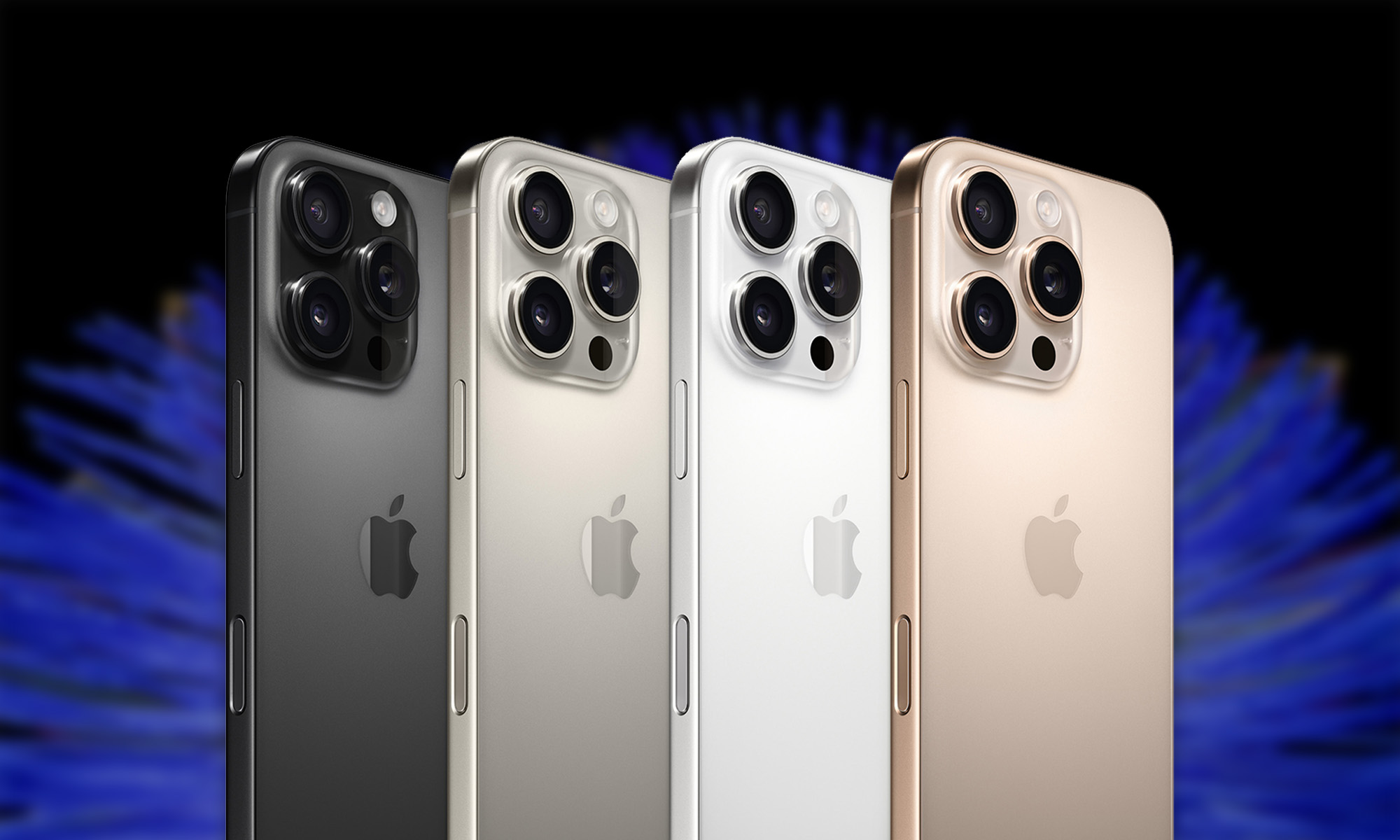
This year’s iPhone 16 Pro and iPhone 16 Pro Max feature slightly larger ProMotion, always-on displays, measuring 6.3 inches and 6.9 inches. Built with Titanium, the Pro phones are lighter than their stainless-steel counterparts. Both are available in black, white, natural and a new desert color (resembling muted gold).
Both models are equipped with the new A18 Pro chip, offering enhanced speed and efficiency over the standard A18 chip. The rear camera array features a 48MP Fusion camera, a 48MP ultrawide lens, and a 12MP telephoto lens. Improvements in video capture include the ability to record 4K video at 120fps, as well as slow-motion recording.
The Pro models also come with four built-in studio-quality microphones, enabling Spatial Audio capture and also support Qi2 wireless charging.
Pre-orders begin on September 13, with prices starting at $999 for the Pro and $1,199 for the Pro Max. Both handsets will be available from September 20.
AirPods 4
As predicted, Apple launched the AirPods 4 at today’s event. The earbuds feature a redesigned shape for better comfort and a more universal fit. Powered by the H2 chip, they promise improved audio quality and support Personalized Spatial Audio. The charging case now has a USB-C port and is the smallest AirPods case Apple has released to date.
Alongside the standard AirPods 4, there’s a model that includes Active Noise Cancellation (ANC) and Transparency mode. A feature called Conversation Awareness will automatically lower the media volume when you start speaking.
The standard AirPods 4 are priced at $129, while the ANC model will cost $179. Both can be pre-ordered today, with availability starting September 20.
New AirPods Max Colors
While the AirPods Max didn’t get a design overhaul, Apple did introduce new color options, including midnight, blue, purple, orange, and starlight. The new models will also support USB-C charging. The updated AirPods Max can be pre-ordered today for $549, with wide availability on September 20.
Apple Watch Series 10
The Apple Watch Series 10 made its debut at the event, boasting Apple’s largest and thinnest display to date. The wide-angle OLED screen and rounded corners provide more room for viewing graphics and text. Additionally, the watch face is now 40% brighter when viewed at an angle.
Powered by the new S10 SiP chip, the Series 10 is optimized for performance, power efficiency, and intelligence-driven features. The watch will include a new Photos watch face, which automatically curates top images from your photo library.
Also Read: How To Clean Your Apple Watch Like A Pro
On the health and fitness front, the Series 10 will be able to detect signs of sleep apnea (pending FDA approval), with the feature expected to roll out in over 150 countries. Other new functions include scuba tracking and support for the Tides app in the upcoming watchOS 11. The Series 10 can also play audio directly from its speaker — a handy feature if you don’t have earbuds available.
The Apple Watch Series 10 will come in polished jet-black aluminum and polished titanium finishes. Pre-orders are available today, and it will be widely available on September 20.





News
ESET Bets On Specialized Security AI At 0.5% The Training Cost
ESET says NeoCortex can estimate an attacker’s next move, with a kill switch and human oversight built in to keep it from going rogue.


A sign-in anomaly, a suspicious process launch and an unusual connection may look harmless alone. Together, they can describe an intrusion that is hard for security to teams to piece together.
To solve that problem, ESET announced ESET NeoCortex on November 4, 2026: a specialized foundational AI model for cybersecurity. It powers ESET LiveCortex, available within the ESET PROTECT Platform, which connects fragmented security signals and turns them into actionable incidents.
Filtering is the main selling point, with LiveCortex processing billions of raw telemetry events daily, and just 0.00111% of them contributing to incidents presented to customers. The aim is less alert fatigue and more analyst time spent on threats that matter.
NeoCortex is built on world-model architecture, learning how digital environments behave and how events relate. ESET says that lets it reconstruct missing incident context, recognize similar past cases and estimate an attacker’s likely next step – what the company calls “minus-one-day defense,” a chance to intervene before the next stage unfolds. ESET points to Black October, the week leading up to October 25, 2026, when critical security issues affecting PHP, Linux, GitLab and other key systems demanded rapid, prioritized responses, as the kind of moment where that context matters.
ESET’s internal research also suggests a specialized model like NeoCortex can be trained at up to 200 times lower cost than a large general reasoning model, while delivering more accurate, defense-focused results. The company credits optimized training, a focus on cybersecurity vocabulary, lower computing requirements and privately owned hardware.
Also Read: Dubai Says Its Deepfake Detector Needs Just 7 Seconds Of Video
“AI is accelerating both cyberattacks and cyberdefenses. With ESET NeoCortex, we are applying our AI investment to develop specialized foundational cybersecurity intelligence that remains under our control and strengthens, rather than replaces, human expertise,” said Juraj Malcho, Chief Technology Officer at ESET.
As part of the design, NeoCortex forms part of a layered architecture combining specialized models, deterministic controls, correlation logic, validation, auditability and expert human oversight. Safeguards include restricted sandboxes, read-only tools, continuous monitoring, defined usage and token limits, a kill switch and human oversight of critical response decisions. The model is also developed and self-hosted on ESET’s own infrastructure, which the company says reduces exposure to shifts among third-party AI providers, including commercial and geopolitical ones.

ESET Bets On Specialized Security AI At 0.5% The Training Cost

Whish Money Opens A Montreal Flagship To Enter The Canadian Market

Abu Dhabi Is Making Its Rulebook Readable To AI, With OpenAI

Binance Reportedly Loses $6.3 Billion In Record Crypto Heist

Robinhood Receives Approval To Launch In The Middle East

G42’s Inception42 Wants AI To Show Its Work Before Investors Commit

Abu Dhabi’s Robot Kitchen Is Serving Up Biryani, Not Burgers

Shokz OpenDots 2 Review: Clip-On Audio Gets A Bass-Heavy Makeover

WHOOP Goes Arabic, Betting On The Gulf’s Appetite For Health Data

Sennheiser’s MOMENTUM 5 Series Bets On Batteries You Can Swap


-
 News3 weeks ago
Abu Dhabi’s Robot Kitchen Is Serving Up Biryani, Not Burgers
-
 Product Reviews3 weeks ago
Shokz OpenDots 2 Review: Clip-On Audio Gets A Bass-Heavy Makeover
-
 News3 weeks ago
Sennheiser’s MOMENTUM 5 Series Bets On Batteries You Can Swap
-

 News2 weeks ago
Checkout.com Reports 20% Higher Payment Acceptance For PRYPCO