News
New Google Update Will Prioritize Quality Websites In Results
The update is billed to be useful for users seeking educational materials, arts and entertainment, plus tech-focused content and shopping results.

A new Google update has just been announced and the company is promising a raft of updates to its search algorithm that will prioritize “quality websites” in the search results, with a view to helping its users uncover more reliable or accurate source material.
Google’s long-term focus has always centered on promoting quality content in search results, and this update seeks to address concerns from some users that the company’s results haven’t been optimal of late.
“We definitely want to speed up the experience for people and make them feel like they’re getting what they’re looking for. We’re trying to show people more helpful and authentic content. […] content made by and for humans, which is a lot of what people seem to be seeking,” says Danny Sullivan, Google Search Spokesperson.
The update, known internally as the “helpful content update“, began a global rollout for English-speaking searches this week, focusing on targeting SEO-first content designed for the sole purpose of ranking on page one.
There’s no news yet as to whether we might be looking at a rerun of 2012’s infamous “Penguin” update, which saw thousands of SEO-focused affiliate sites wiped from search results, destroying the income streams of many internet entrepreneurs.
Google says its product testing indicates that the algorithm update will prove especially helpful for results relating to shopping, arts and entertainment, tech-related content, and online learning. The search giant will simultaneously tweak its existing product review results by adding more firsthand and in-depth experiences to reviews.
Also Read: Cameo’s New Feature Allows Live Calls With Celebrities
Instead of sending users to a page that aggregates and rounds up other review sites, or to suggestions from people who have never used a product, Google’s spokesperson Danny Sullivan says the company is working to unearth more experienced product reviews and opinions.
So the big question is, should website owners be worried? Google maintains that the update will not impact results if a site isn’t primarily spammy or SEO-driven, but instead focused on genuinely helpful content. Let’s wait and see how things progress over the coming months!



News
NVIDIA Puts GPT-5.5 Codex In Hands Of 10,000 Staff
The chipmaker has significantly expanded OpenAI’s latest model across teams from engineering to HR under tight internal controls.
NVIDIA has started rolling out OpenAI’s GPT-5.5 model through the Codex coding agent to more than 10,000 employees, extending the tool well beyond software teams and into core business functions.
The deployment covers engineering, product, legal, marketing, finance, sales, HR, operations and developer programs. Staff are using Codex for coding, internal research and routine knowledge work as companies test whether AI agents can move from demos to daily use.
GPT-5.5 is running on NVIDIA’s GB200 NVL72 rack-scale systems, linking OpenAI’s newest model directly to the chipmaker’s latest infrastructure push. NVIDIA said the systems cut cost per million tokens by 35 times and raise token output per second per megawatt by 50 times versus earlier generations.
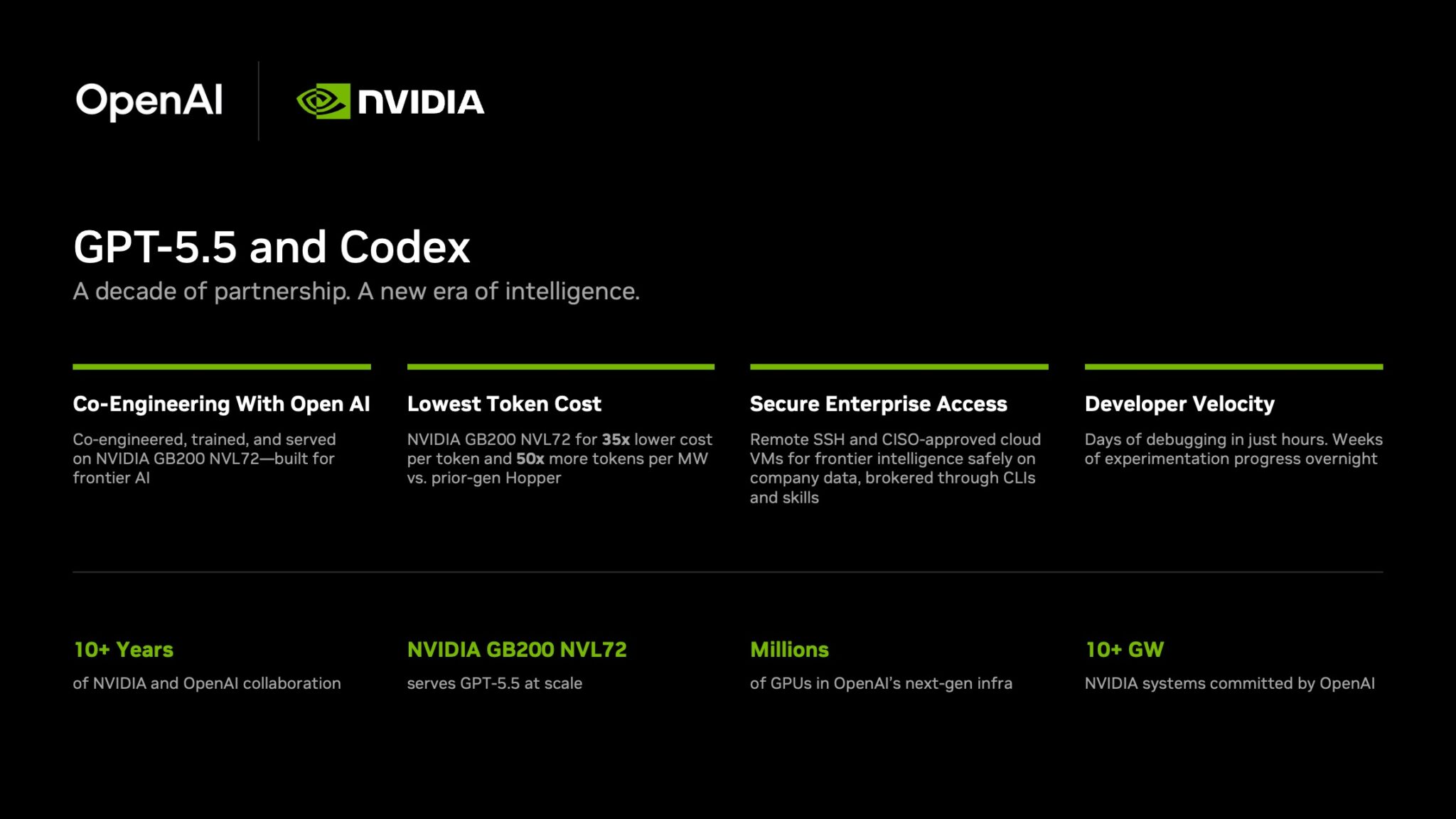
Inside the company, it says the effects are immediate. Debugging work that once took days is being finished in hours and experiments across large codebases that used to stretch over weeks are now handled overnight. Teams are also building features from natural-language prompts with fewer failed runs.
In a company-wide note urging staff to adopt the tool, CEO Jensen Huang wrote: “Let’s jump to lightspeed. Welcome to the age of AI.”
Security remains central to the rollout. Codex can connect through Secure Shell to approved cloud virtual machines, allowing agents to work with company data without moving it outside approved environments. NVIDIA said it assigned cloud VMs to employees so agents run in isolated sandboxes with full audit trails.
Also Read: Deezer Says AI Tracks Now Make Up 44% Of Uploads
The company added that the setup uses a zero-data-retention policy. Access to production systems is read-only through command-line tools and internal automation layers.
The move also highlights NVIDIA’s long relationship with OpenAI. NVIDIA said the partnership began in 2016, when Huang personally delivered the first DGX-1 AI supercomputer to OpenAI’s San Francisco office.
The two companies have since worked across hardware and model deployment. NVIDIA also said OpenAI plans to deploy more than 10 gigawatts of NVIDIA systems for future AI infrastructure.
For Gulf markets pouring money into sovereign AI and enterprise automation, the signal is clear: internal AI agents are moving from pilot phase to standard tooling.

NVIDIA Puts GPT-5.5 Codex In Hands Of 10,000 Staff

Deezer Says AI Tracks Now Make Up 44% Of Uploads

Yango Ride Introduces In-Chat Trip Planning In ChatGPT

Nano Banana 2 Arrives In MENA For Google Gemini Users